
Key takeaways
- HVLP (High Volume Low Pressure): The standard for compliant base and clear in the US. Uses high air volume (9-13 CFM) at low cap pressure (around 10 PSI at the air cap, 26-29 PSI at the inlet). Transfer efficiency above 65%. Best finish quality, but demands a larger compressor.
- LVLP (Low Volume Low Pressure): Needs less air (4.5-7 CFM) at similar low pressure. Easier to run on a smaller 20-30 gallon compressor. Atomization is slightly coarser than HVLP, so it can leave more texture in clear if you don’t compensate with technique. Good for home garages and spot repairs.
- RP (Reduced Pressure / Compliant): Such as the Sata RP series. Operates at higher inlet pressure (29-35 PSI) with faster application speed. Higher build per coat than HVLP, excellent for clear coat flow-out, but lower transfer efficiency and more overspray. Preferred by many production shops for clear.
- Conventional High Pressure: Largely obsolete for automotive refinishing due to VOC regulations and 25-35% transfer efficiency. Avoid for base/clear.
The best automotive paint guns for clear coat and base coat are HVLP gravity-feed guns with a 1.3mm to 1.4mm fluid tip, because that range atomizes both base and clear without excessive overspray while staying compliant with most shop air setups.
For base coat you want fine atomization and even metallic control, for clear you want high material flow and gloss without orange peel. That difference is why nozzle size, air cap design, and compressor capacity matter more than brand alone.
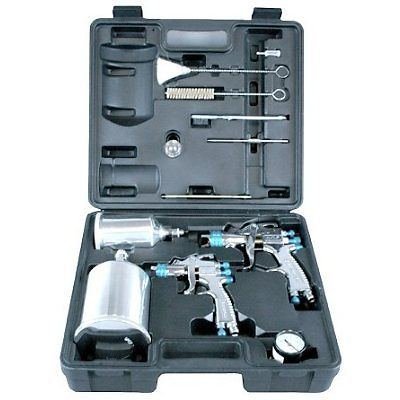
Devilbiss 802342 StartingLine Spray Gun Kit
Included for 'Best Automotive Paint Guns for Base Coat and Clear Coat' as a relevant option in this category; details come from the product listing.
View on AmazonHVLP vs LVLP vs RP: Which Type Actually Fits Base and Clear
Most beginners assume all spray guns are the same. The transfer efficiency, air consumption, and atomization quality vary significantly by type:
- HVLP (High Volume Low Pressure): The standard for compliant base and clear in the US. Uses high air volume (9-13 CFM) at low cap pressure (around 10 PSI at the air cap, 26-29 PSI at the inlet). Transfer efficiency above 65%. Best finish quality, but demands a larger compressor.
- LVLP (Low Volume Low Pressure): Needs less air (4.5-7 CFM) at similar low pressure. Easier to run on a smaller 20-30 gallon compressor. Atomization is slightly coarser than HVLP, so it can leave more texture in clear if you don’t compensate with technique. Good for home garages and spot repairs.
- RP (Reduced Pressure / Compliant): Such as the Sata RP series. Operates at higher inlet pressure (29-35 PSI) with faster application speed. Higher build per coat than HVLP, excellent for clear coat flow-out, but lower transfer efficiency and more overspray. Preferred by many production shops for clear.
- Conventional High Pressure: Largely obsolete for automotive refinishing due to VOC regulations and 25-35% transfer efficiency. Avoid for base/clear.
For a buying decision: Choose HVLP if you want the best all-around base and clear finish and have the air to support it. Choose LVLP if your compressor is underpowered. Choose RP if you spray clear all day and prioritize speed and high gloss over material savings.
Decision Matrix: Match Your Setup to the Right Gun
| Situation | Recommended Gun Type | Ideal Nozzle | Why |
|---|---|---|---|
| Home garage, 20-30 gal compressor (5-7 CFM @ 90 PSI) | LVLP gravity-feed | 1.3mm – 1.4mm | Will run without pressure drop; HVLP will starve and cause mottling |
| 60-gal 2-stage compressor (11+ CFM @ 90 PSI), doing full resprays | HVLP gravity-feed | 1.3mm for base, 1.4mm for clear (or 1.3mm for both) | Best atomization and metallic control, optimal clear leveling |
| Production shop, need fast clear application | RP | 1.3mm RP | Higher material flow and faster coverage, fewer coats for high build clear |
| Primarily metallic / pearl base coats | HVLP | 1.3mm | Finer atomization prevents mottling and tiger stripes in metallics |
| Waterborne base coat system | HVLP with stainless / coated internals | 1.3mm – 1.4mm | Corrosion resistance and specific air cap for waterborne atomization |
Nozzle Size by Job: What 1.2mm to 1.8mm Actually Does
Nozzle (fluid tip) size controls how much material flows and how it breaks up. You do not need a different gun for every step, but you do need the right tip:
- 1.2mm – 1.3mm: Ideal for base coat, especially metallics, pearls, and waterborne. Produces a fine, controlled mist that lays flakes flat. A 1.3mm is the most versatile compromise for both base and clear.
- 1.3mm – 1.4mm: Ideal for clear coat. Solvent clears are slightly more viscous and benefit from the extra flow to level smoothly. A 1.4mm lays a wetter coat with less dry spray, reducing orange peel if your technique is correct.
- 1.7mm – 1.8mm: For high-build primer and surfacer only. Too large for base or clear; you will flood the panel and get runs, solvent pop, and poor metallic orientation.
- 1.5mm+ for base/clear: Avoid unless spraying very high-viscosity specialty clears or single-stage. It over-applies material.
Practical buying tip: Many pro-level guns like the Anest Iwata W-400 Bellaria, SATAjet 5500 RP/HVLP, and DeVilbiss GTi Pro Lite use interchangeable tip/air cap sets. Buying one gun body with both a 1.3mm and 1.4mm setup is usually cheaper and more consistent than buying two cheap guns.
Recommended Tip Setups for Base and Clear
| Product Class | Base Coat Setup | Clear Coat Setup | Inlet Pressure Range | Air Consumption |
|---|---|---|---|---|
| HVLP Gravity (e.g., Anest Iwata W-400, SATAjet 5500 HVLP) | 1.3mm, 26-28 PSI inlet | 1.4mm, 26-28 PSI inlet | 26-29 PSI | 9.5 – 12.5 CFM |
| LVLP Gravity (e.g., Anest Iwata LPH400 LV, Astro LVLP) | 1.3mm, 18-22 PSI inlet | 1.4mm, 20-23 PSI inlet | 18-23 PSI | 4.8 – 7.0 CFM |
| RP Gravity (e.g., SATAjet 5500 RP, DeVilbiss GTi Pro Lite RP) | 1.3mm RP, 29-32 PSI inlet | 1.3mm RP, 29-35 PSI inlet | 29-35 PSI | 9.0 – 11.5 CFM |
| Disposable Cup System (e.g., 3M Accuspray HG18) | 1.3mm PPS atomizing head | 1.4mm PPS atomizing head | 20-26 PSI | 7.5 – 9.0 CFM |
Air Requirements: Will Your Compressor Keep Up?
This is where most bad purchase decisions happen. A gun that needs 12 CFM will not run correctly on a compressor rated at 6 CFM @ 90 PSI, even if it can hit the pressure.
Worked Calculation: Do You Have Enough CFM?
Use this calculation before buying:
Step 1: Find the gun’s rated consumption at working pressure. Example: SATAjet 5500 HVLP 1.3mm = 9.5 CFM @ 29 PSI inlet.
Step 2: Find your compressor’s delivered CFM @ 90 PSI. Example: A typical 60-gallon 3.5 HP 2-stage unit is usually rated 11.5 CFM @ 90 PSI.
Step 3: Apply the 1.3x duty cycle rule. Your compressor’s rated CFM should be at least 1.3x the gun’s requirement for continuous spraying without pressure drop.
Calculation: 9.5 CFM (gun) x 1.3 = 12.35 CFM required. An 11.5 CFM compressor would cycle constantly and cause pressure fluctuation during a full clear coat pass, leading to inconsistent atomization and patchy gloss. You would either need a larger compressor or switch to an LVLP gun rated at 6.0 CFM (6.0 x 1.3 = 7.8 CFM required), which that compressor can handle comfortably.
Rule of thumb: For HVLP/RP continuous clear coats, you need a true 60-gallon 2-stage. For LVLP spot/panel work, a 30-gallon unit with 6-7 CFM is often sufficient. Always measure pressure at the gun handle with a regulator/gauge, not just at the wall regulator.
Concrete Settings for Base and Clear
These are starting points for solvent base and standard 2:1 clear. Fine-tune per your technical data sheet:
- Base Coat (HVLP 1.3mm): Inlet 26-28 PSI (results in ~10 PSI at cap), fluid knob 2.5 turns out from closed, fan wide open then back 1/4 turn, trigger 50-75% for tack coats, 75-100% for wet coats. Gun distance 6-7 inches, 50% overlap, gun speed ~12 inches per second.
- Base Coat metallics: Same pressure, reduce fluid slightly (2 turns out) and add a final drop coat / orientation coat at 8-10 inches distance, lower pressure by 2-3 PSI to even metallics.
- Clear Coat (HVLP 1.4mm or RP 1.3mm): Inlet 26-28 PSI for HVLP or 29-32 PSI for RP, fluid 2.5-3 turns out, fan fully open. Full wet coats, 6-8 inches distance, 60-75% overlap, slower pass ~8-10 inches per second to maintain a wet edge. Flash 10-15 minutes between coats per clear type.
- Why these values: Base needs less fluid and faster movement to avoid flooding metallics; clear needs more fluid and slower movement to flow and level. Excess inlet pressure over-atomizes clear and causes dry spray/orange peel, while too little pressure causes large droplets and sags.
Cleanup Demands: Where Cheap Guns Cost You Time
Cleanup is not just about convenience; leftover catalyst in a clear coat gun will ruin the next job.
- Traditional gravity-feed (all metal): Requires full breakdown after clear: empty cup, wipe, flush with gun wash thinner, remove air cap, fluid tip and needle, soak and brush. Time: 10-15 minutes. If spraying waterborne, flush immediately with water then solvent to prevent corrosion.
- PPS / disposable cup systems (3M PPS 2.0, DeVilbiss DeKups): Liner and cup are disposable, dramatically reducing solvent use and cleaning time to 3-5 minutes. You still must clean the air cap and fluid tip, but the cup itself does not need washing. Ideal if you spray color and clear back-to-back.
- Chrome vs stainless internals: Stainless or Teflon-coated fluid paths (found on Iwata and Sata mid-to-pro models) resist clear coat buildup and waterborne corrosion and clean faster than untreated brass.
Do not soak the entire gun body. Soaking damages air seals and packings. Only soak the air cap, tip, and cup. Lubricate the needle packing with a drop of gun oil after cleaning.
What to Buy Based on Budget and Goals
In 2026 the market breaks into three functional tiers, not just price tiers:
- Entry LVLP (usually $80-$180): Brands like Astro, TCP Global, or generic LVLP gravity guns with 1.3/1.4mm tips. Acceptable for hobby base/clear on one or two panels. Finish quality is limited by machining tolerances; expect more cleanup and less consistent atomization.
- Mid-Range HVLP/LVLP (usually $250-$500): DeVilbiss StartingLine Plus, Tekna ProLite, Anest Iwata W-400 / LPH400. This is the value sweet spot for enthusiasts doing full cars. Better air caps, smoother fluid delivery, and available repair parts.
- Professional HVLP/RP (usually $500-$900): SATAjet 5500, Anest Iwata WS-400 Series, DeVilbiss GTi Pro Lite. Tightest tolerances, best atomization, and most consistent fan pattern. Justified if you spray weekly or charge for work; the material savings from better transfer efficiency alone can offset the cost over many gallons of clear.
If you can only buy one gun, get a mid-range or pro HVLP 1.3mm. It will spray 90% of base and clear jobs well. Add a 1.4mm tip for clear later if your compressor supports it. If your compressor is small, prioritize an LVLP 1.3mm/1.4mm set over a cheap HVLP you cannot feed.
Common Mistakes That Ruin Base and Clear With a Good Gun
- Running the gun at wall pressure instead of gun inlet pressure. A 30-foot 1/4-inch hose can drop 5-8 PSI.
- Using a 1.8mm primer tip for base to “get more coverage.” It floods metallics and causes blotching.
- Thinning clear too much to compensate for low air. Fix the air supply, not the viscosity.
- Skipping the water/oil separator. Even a small amount of moisture causes fisheyes in base and clouding in clear.
FAQ
Can I use the same 1.3mm gun for both base and clear?
Yes. A 1.3mm HVLP is the standard compromise and will produce show-quality results for both if your technique is correct. A 1.4mm will lay clear slightly wetter and level faster, but the difference is subtle if you maintain proper overlap and gun speed. If you buy one tip, make it 1.3mm.
Why does my clear look like orange peel even with a good gun?
Usually it’s too much inlet pressure over-atomizing the clear, gun distance too far, or moving too fast, which dries the droplets before they flow together. Reduce inlet by 2 PSI, get to 6-7 inches, slow your pass, and increase fluid a quarter turn. Also check that your flash time is not too long between coats.
Do I need a separate gun for waterborne base coat?
You do not need a completely different model, but you need a gun with stainless or coated internals and an air cap designed for waterborne. Waterborne is more corrosive and atomizes differently than solvent. Many Iwata and Sata waterborne versions use a different air cap for the same gun body.
