
Key takeaways
- Rinse the filter basket or bag after every use. A half-full fine filter can reduce suction by 30% to 40% and force the motor to draw more power.
- Run robots on floor-only mode for daily maintenance and save full wall/waterline modes for weekly deep cleans. Wall climbing uses significantly more battery.
- Do not store batteries fully depleted. Recharge to 80-100% after each session and store indoors above 50 degF / 10 degC. Cold storage reduces next-cycle runtime.
- For handhelds, use the correct filter: use the all-purpose bag for leaves and switch to the sand-and-silt micro-filter only when needed, as micro-filters restrict flow and shorten runtime.
- Seal the vacuum head to the pool floor. Handheld suction is lost if you lift the head at an angle while vacuuming — keep the head flat and move slowly at about 1 foot per second.
The best cordless pool vacuums for most owners in 2026 are cordless robotic models like the Dolphin Liberty 300 for full automation and handheld stick vacuums like the Pool Blaster Centennial and Water Tech Volt FX-8Li for fast spot-cleaning, with your choice depending on whether you need hands-free floor and wall coverage or quick debris pickup without waiting for a full cycle.
How to Choose: 6 Specs That Actually Matter
Buying a cordless pool vacuum is a trade-off between runtime, suction, and how much debris it can hold before it loses performance. Use these six criteria to filter models before you look at price.

WYBOT C1 Cordless Robotic Pool Vacuum for Inground Pools, Professional
Included for 'Best Cordless Pool Vacuums for Easy Cleaning' because the listing specifies Professional, details this guide uses to compare options.
View on Amazon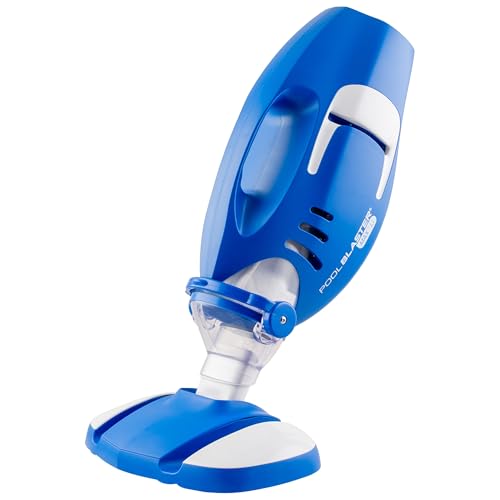
POOL BLASTER 2026 Max Cordless Pool Vacuum for Above & Inground Pools
Included for 'Best Cordless Pool Vacuums for Easy Cleaning' as a relevant option in this category; details come from the product listing.
View on Amazon1. Battery Runtime vs. Pool Size
Runtime determines if a vacuum can finish in one charge. Robotic cordless units run 90 to 150 minutes, handheld pole vacuums run 45 to 75 minutes of continuous suction. Runtime alone is meaningless without pool size, because a robot moves slowly.
2. Debris Capacity and Filter Type
Capacity is measured in liters or gallons of debris chamber volume. Small handhelds hold 0.5 to 1.3 liters, good for leaves and sand after a storm but requiring mid-clean empties for heavy loads. Robotic cordless models hold 2 to 4 liters and use fine filter baskets or ultra-fine panels for silt and algae. If your pool sits under trees, capacity beats suction power.
3. Suction Strength and Flow Rate
Handhelds are rated by gallons per minute (GPM) or liters per minute, robots by motor wattage and suction inlet design. For sand, silt, and dead algae you need strong seal-to-surface suction and a fine filter, not just high GPM. For large leaves and acorns you need a wide mouth and high flow.
4. Pole Compatibility
Handheld cordless vacuums either include a telescopic pole or attach to a standard 1.25-inch telescopic pool pole via a pole adapter. If you already own a pole, check for a universal pole connector. Robotic cordless vacuums do not use a pole at all.
5. Pool-Surface Suitability
Vinyl liner pools need soft brushes and non-abrasive wheels to avoid tearing. Concrete, gunite, and pebble require aggressive PVC brushes and stronger climbing ability for walls and waterline. Fiberglass sits in the middle. Always match brush type to liner warranty requirements.
6. Charging Time and Battery Type
Most 2026 models use lithium-ion batteries. Handhelds charge in 3 to 4 hours, robots in 4 to 6 hours with magnetic or inductive charging docks. Models with quick-charge or swappable batteries cut downtime if you clean more than once per week.
Cordless Pool Vacuum Types Compared
| Model Class / Example | Battery Runtime | Charging Time | Debris Capacity | Suction / Flow | Pole Needed? | Best Surface |
|---|---|---|---|---|---|---|
| Cordless Robotic – Dolphin Liberty 300 | Up to 150 min | 4-5 hours | ~3.5 L with fine + ultra-fine filters | Dual drive motors, wall/waterline scrub | No | Gunite, pebble, vinyl, fiberglass |
| Cordless Robotic – Aiper Scuba S1 | 90-150 min (mode dependent) | 4-6 hours | ~3.2 L basket | Single suction inlet, caterpillar tracks | No | Flat-bottom vinyl and fiberglass, light wall climb |
| Handheld Stick – Pool Blaster Centennial | Up to 60 min | ~4 hours | ~0.9 L reusable filter bag | ~45-55 GPM high-flow pump | Yes, standard 1.25″ pole (included) | All surfaces, soft bristles for vinyl |
| Handheld Commercial – Water Tech Volt FX-8Li | 60-75 min | ~4 hours | ~1.3 L with extra-large debris bag | ~57 GPM, strong leaf pickup | Yes, push-button pole adapter | Vinyl, concrete, commercial pools |
| Compact Handheld – Kokido Telsa 80 | 45-60 min | 3-4 hours | ~0.6 L | ~30-35 GPM, micro-filter for silt | No, internal telescopic handle | Small above-ground, spas, vinyl |
Worked Calculation: Will One Charge Clean Your Pool?
Do not rely on advertised runtime alone. Estimate cleaning coverage with this simple power-budget calculation:
Formula: Cleanable Area = Robot Speed x Cleaning Path Width x Runtime x Efficiency Factor
Most cordless robots move at 35 to 50 feet per minute, with a 10 to 12 inch (0.83 to 1 ft) cleaning path. Efficiency factor of 0.7 accounts for turns, wall climbs, and overlap.
Example 1 – Large robot on a 16×32 ft rectangular pool (512 sq ft floor):
Speed 45 ft/min x Path 1 ft x 100 min runtime x 0.7 = 3,150 sq ft of path coverage. Even with 40% overlap for walls and waterline, that is more than enough for one full floor pass plus walls in a single charge. A 150-minute model like the Dolphin Liberty 300 can do the same pool on Eco mode and still have reserve for a second waterline cycle.
Example 2 – Handheld stick vacuum:
Handhelds are manual, so coverage depends on you. A Pool Blaster Centennial at 50 GPM with a 10-inch vacuum head cleans a 16×32 ft pool floor in about 18 to 25 minutes of active vacuuming if you move at 20 ft/min. A 60-minute battery therefore allows for two full passes or one pass with heavy leaf loads that require frequent stops to empty the 0.9L chamber. If your pool collects more than ~2 liters of leaves after a windstorm, expect to empty a handheld 2 to 3 times mid-clean.
Use this to decide: If your floor area is over 600 sq ft or you want wall cleaning without effort, choose a 100+ minute robotic model. If your pool is under 400 sq ft or you only need weekly spot cleaning, a 45 to 60 minute handheld is faster and usually $400–$600 less expensive.
Decision Matrix: Match Your Pool to the Right Vacuum
| Your Situation | Best Choice | Why |
|---|---|---|
| Inground pool, 15,000+ gallons, trees nearby, want set-and-forget | Cordless robotic (Dolphin Liberty series, Aiper Scuba S1 Pro, Wybot S1) | Large debris basket, scheduled cleaning, wall and waterline climbing, no pole work |
| Above-ground or small inground vinyl pool, quick weekly clean | Compact handheld (Kokido Telsa 80, Pool Blaster Catfish 2) | Lightweight, built-in handle, micro-filter captures sand without draining the pool |
| Heavy leaves, acorns, or sand after storms | High-flow handheld with large bag (Water Tech Volt FX-8Li, Pool Blaster Max HD) | Largest GPM and debris capacity in cordless class, empties in seconds |
| Algae, silt, or fine dust that clouds water | Robotic with ultra-fine filter or handheld with micro-filter cartridge | Standard mesh lets silt pass through; you need pleated ultra-fine or sand-and-silt bag |
| Limited storage or no place to charge a robot | Handheld stick with standard pole | Stores vertically in a shed, charges via wall adapter, no dock needed |
Surface and Power Considerations by Pool Type
Vinyl Liner Pools
Choose soft-bristle brushes and wheeled models that do not drag. The Dolphin Liberty line and Pool Blaster Centennial both use non-abrasive components safe for vinyl. Avoid stiff rotating brushes that can wear the liner at the seams. Use the fine filter setting for sand to prevent liner abrasion.
Concrete, Gunite and Pebble
You need aggressive scrubbing and strong wall grip. Cordless robots with dual brushes and high-torque tracks climb better on rough surfaces. Handhelds work on any surface but require you to apply pressure on algae spots — use a nylon brush head first, then vacuum.
Fiberglass and Painted Pools
These surfaces stain easily from metal debris. Look for models with internal filter bags that trap rust particles rather than recirculating them. Aiper and Wybot robots with dual-layer filtration are effective here.
Maximizing Battery Life and Suction
Lithium-ion runtime drops when filters are clogged or water is cold. To keep advertised performance:
- Rinse the filter basket or bag after every use. A half-full fine filter can reduce suction by 30% to 40% and force the motor to draw more power.
- Run robots on floor-only mode for daily maintenance and save full wall/waterline modes for weekly deep cleans. Wall climbing uses significantly more battery.
- Do not store batteries fully depleted. Recharge to 80-100% after each session and store indoors above 50 degF / 10 degC. Cold storage reduces next-cycle runtime.
- For handhelds, use the correct filter: use the all-purpose bag for leaves and switch to the sand-and-silt micro-filter only when needed, as micro-filters restrict flow and shorten runtime.
- Seal the vacuum head to the pool floor. Handheld suction is lost if you lift the head at an angle while vacuuming — keep the head flat and move slowly at about 1 foot per second.
What to Expect on Price and Longevity
In 2026, compact handheld cordless vacuums usually cost $150–$350, high-flow pole vacuums usually $350–$600, and cordless robotic cleaners usually $700–$1,300 depending on navigation, filtration levels, and battery size. Replacement filters typically cost $30–$80, and lithium-ion packs are usually rated for 300 to 500 full cycles before capacity drops to about 80%.
If you clean twice weekly, a handheld will last 3 to 5 seasons with filter replacements, while a cordless robot with proper winter storage typically lasts 4 to 6 seasons before battery replacement is needed.
FAQ
Can a cordless pool vacuum replace a pool filter pump vacuum?
For routine debris, yes. Cordless vacuums have their own motor and filter so they do not require the filter pump to run. For heavy algae blooms or opening a green pool, you still need to vacuum to waste through the main filtration system to avoid recirculating spores.
How long does it take to charge a cordless pool vacuum completely?
Most handhelds need 3 to 4 hours, most cordless robots need 4 to 6 hours from empty. Using a standard outlet is sufficient; fast chargers included with newer Wybot and Aiper models can cut 30 to 45 minutes but do not overcharge overnight.
Do cordless robots clean walls and the waterline?
Mid-range and premium cordless robots like the Dolphin Liberty 300 and Wybot S1 are designed to climb walls and scrub the waterline using tracks and brushes. Entry-level cordless robots and all handheld stick models clean the floor only unless you manually guide them up the wall.
