
Key takeaways
- Single coils: clear attack, bright clean tones and more audible electrical hum. Good for pop, funk, blues and classic Strat-style sounds.
- Humbuckers: fuller output, less single-coil hum and a smoother distorted tone. Good for rock, hard rock and metal.
- HSS: the safest all-round arrangement because it combines a bridge humbucker with two single coils.
- HSH: broad coverage with a strong emphasis on lead and heavier sounds.
The best beginner electric guitars for easy playing are the Yamaha Pacifica 112V for the most forgiving all-round experience, the Squier Sonic Stratocaster for a light and familiar starter platform, and the Ibanez GRX70QA for players who prefer a slimmer neck and heavier sounds.
Quick comparison: which beginner guitar fits you?
| Guitar | Neck and scale | Pickup layout | Typical body weight | Best match | Typical guitar-only price |
|---|---|---|---|---|---|
| Yamaha Pacifica 112V | Comfortable C shape, 25.5-inch scale, 22 frets | HSS, Alnico pickups, bridge humbucker can split | About 3.3–3.6 kg | One guitar for blues, rock, pop and clean sounds | Usually $350–$450 |
| Squier Sonic Stratocaster | Thin C shape, 25.5-inch scale, 21 frets | Three single-coil pickups | About 2.8–3.3 kg | Smaller players and the lowest-cost entry | Usually $200–$280 |
| Squier Affinity Stratocaster | C shape, 25.5-inch scale, 21 frets | Three single coils | About 3.0–3.5 kg | A traditional Strat feel with a more substantial build | Usually $280–$380 |
| Ibanez GRX70QA | Thin GRX neck, 25.5-inch scale, 24 frets | HSH, two humbuckers and a middle single coil | About 3.2–3.6 kg | Fast-feeling lead playing and rock or metal | Usually $250–$350 |
| Jackson JS11 Dinky | Thin U-shaped neck, 25.5-inch scale, 24 frets | Two high-output humbuckers | About 3.2–3.7 kg | Distortion, palm muting and modern metal | Usually $220–$320 |
Weights and prices vary by finish, production run and region. The weight figures are useful for planning, not a guarantee for every individual instrument.

Fender Squier Debut Stratocaster Beginner Electric Guitar Kit, Black
Included for 'Best Beginner Electric Guitars for Easy Playing' because the listing specifies Black, details this guide uses to compare options.
View on Amazon
DONNER DST-80 39” Beginner Electric Guitar Kit with Amp, SSS Pickups
Included for 'Best Beginner Electric Guitars for Easy Playing' because the listing specifies SSS Pickups, details this guide uses to compare options.
View on Amazon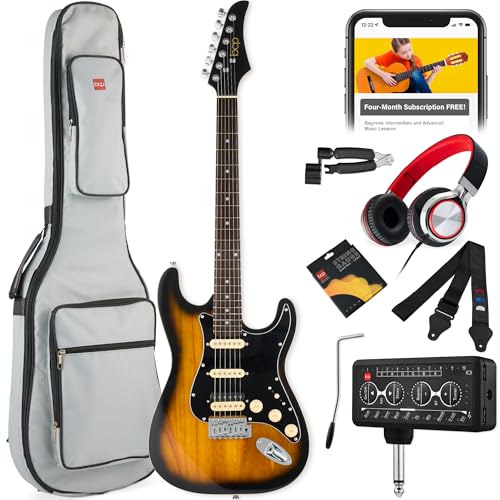
Best Choice Products Beginner HSS Electric Guitar Kit w/Headphone Amp, Padded Gig-Bag, Headphones, Guitar Strap - Sunburst/Black
Included for 'Best Beginner Electric Guitars for Easy Playing' because the listing specifies Padded Gig-Bag and Headphones, details this guide uses to compare options.
View on AmazonBest overall: Yamaha Pacifica 112V
The Pacifica 112V is the strongest choice when “beginner” does not mean “something to replace quickly.” Its C-shaped neck is neither unusually chunky nor extremely thin, so it suits a wide range of hand sizes. The 25.5-inch scale gives the familiar Strat-style string tension, while the 22-fret layout leaves room for basic lead playing without making the neck feel crowded.
Its HSS pickup arrangement is particularly useful for a first guitar. The neck and middle single coils produce clear clean tones for chords, funk and pop, while the bridge humbucker adds a thicker sound for rock. On the 112V, the bridge pickup can also be coil-split, giving you another brighter option. That flexibility matters because a new player may not yet know whether they prefer clean rhythm, blues, punk or heavier music.
The main compromise is weight. It is not excessively heavy, but a smaller player may find a Squier Sonic easier to hold during a long practice session. Yamaha usually sells the guitar without a complete amplifier bundle, so budget separately for an amp, cable, strap and tuner.
Best lightweight budget option: Squier Sonic Stratocaster
The Squier Sonic Stratocaster is a practical choice when low weight and low initial cost matter most. Its thin C-shaped neck is easy to wrap a beginner’s hand around, and the three-single-coil layout provides the classic bright Stratocaster character. The 25.5-inch scale is longer than a short-scale beginner guitar, but this is also the standard scale used by many full-size electric guitars.
Single-coil pickups are clear and articulate, which helps beginners hear whether a chord is ringing cleanly. They also have more hum than humbuckers, especially with high-gain amplification or near electrical equipment. That is normal rather than a fault.
The Sonic’s lower price can mean more variation in factory setup. Check the string height, tuning stability and fret ends before committing, or reserve part of the budget for a professional setup. Starter packs can be convenient because they commonly include a small amplifier, cable and strap, but the included amp is usually the first component a player will outgrow.
Best traditional Strat upgrade: Squier Affinity Stratocaster
The Affinity Stratocaster is worth considering when you want the familiar three-single-coil format but prefer a somewhat more substantial instrument than the Sonic series. Its C-shaped neck remains approachable, and the 21-fret layout keeps the controls and pickup configuration simple.
Choose it over the Sonic if you expect to practise regularly, want a slightly more developed platform for upgrades, or dislike extremely lightweight instruments. Choose the Pacifica 112V instead if you want a bridge humbucker and broader tonal coverage for roughly the same overall budget once accessories are included.
Best for a slim neck and heavier sounds: Ibanez GRX70QA
The Ibanez GRX70QA suits a player who finds traditional Strat-style necks too full or who mainly wants rock and metal tones. Its GRX neck profile is slim, and the 24-fret design gives two extra frets compared with many traditional beginner guitars. The HSH pickup configuration covers a lot of ground: the humbuckers provide a thicker distorted sound, while the middle single coil adds a sharper, cleaner option.
The trade-off is that a slim neck is not automatically easier for everyone. Players with larger hands may prefer a fuller C shape, and high-output pickups can make an inexpensive amplifier sound harsh if gain and treble are set too high. Start with moderate gain and adjust upward only after the basic chord sound is clean.
Best for modern metal: Jackson JS11 Dinky
The Jackson JS11 Dinky is aimed more clearly at metal than the other recommendations. Its thin U-shaped neck, 24 frets and two humbuckers make it comfortable for riffing, bends and lead lines. The 25.5-inch scale keeps the low strings reasonably firm in standard tuning, although players who use very low tunings may eventually want heavier strings and a professional setup.
It is less versatile for sparkling clean Strat-style sounds because it has no single-coil pickup. The bridge humbucker also produces more output than many basic practice amplifiers expect. This is a good choice when the player already knows that distorted riffs are the priority, not when they want one guitar to cover every genre equally.
Neck shape, scale and body weight: what actually affects ease of playing?
Neck shape
A thin C or slim U profile can make fretting feel less tiring for smaller hands and fast single-note exercises. A medium C profile often gives better support for beginners learning open chords. Neither shape removes the need to press directly behind the fret; poor finger placement can make any guitar feel difficult.
Scale length
A 24.75-inch scale, found on some shorter-scale electric guitars, slightly reduces string tension and fret spacing. The guitars above mostly use a 25.5-inch scale, which gives a consistent full-size feel and stronger tension. If bending feels difficult, lighter strings such as .009–.042 may help, but changing strings can require a small setup adjustment.
Body weight and balance
A guitar under about 3.2 kg is often more comfortable for a child, smaller adult or anyone practising while seated. Balance matters as much as the number on a scale: a neck that drops toward the floor forces the fretting hand to support it. Try the guitar with a strap, even while sitting, because this reveals neck dive that may not be obvious when holding it briefly.
Pickup choice: match the sound to the practice plan
- Single coils: clear attack, bright clean tones and more audible electrical hum. Good for pop, funk, blues and classic Strat-style sounds.
- Humbuckers: fuller output, less single-coil hum and a smoother distorted tone. Good for rock, hard rock and metal.
- HSS: the safest all-round arrangement because it combines a bridge humbucker with two single coils.
- HSH: broad coverage with a strong emphasis on lead and heavier sounds.
Pickup labels do not determine quality by themselves. A well-adjusted budget single coil can be more useful to a beginner than a poorly set up guitar with expensive-looking hardware.
Budget the complete beginner setup
A guitar is only part of the system. A realistic low-cost setup usually needs an amplifier, instrument cable, tuner, strap, picks and spare strings. For example, a guitar costing $280 plus a $120 practice amplifier, $20 cable, $15 tuner, $20 strap and $10 picks totals about $465 before tax. A $350 guitar with no accessories can therefore cost more to start than a $250 starter pack.
Small practice amplifiers with a headphone output are especially useful in shared homes. Look for a clean channel, gain control, headphone output and an auxiliary or Bluetooth input if you want to play along with lessons or backing tracks. Effects are helpful, but they should not outweigh basic controls and quiet practice.
Setup checks before the first lesson
- Tune the guitar and check intonation. Play an open string, then its 12th-fret harmonic and fretted 12th-fret note. A large difference suggests the bridge needs adjustment.
- Inspect the action. If strings sit very high above the fretboard, fretting will require unnecessary force. If they buzz heavily on many frets, the neck relief or fretwork may need attention.
- Check the neck relief. With the first and last fret held, there should normally be a small gap around the middle of the neck. Do not turn the truss rod without the correct tool and instructions; a technician is safer for a first setup.
- Test every pickup and control. Rotate the volume and tone knobs while plugged in. Crackling may indicate a dirty control, while a dead position may require repair.
- Replace uncomfortable strings. Factory strings can be old or heavy. A fresh .009–.042 or .010–.046 set is a common starting point, but the guitar should be adjusted if the gauge changes substantially.
Final choice
Choose the Yamaha Pacifica 112V if you want the most adaptable long-term beginner guitar. Choose the Squier Sonic Stratocaster when low weight and minimum cost are the priority, or the Affinity Stratocaster for a more traditional step up. Pick the Ibanez GRX70QA for a slim neck and versatile rock tones, and the Jackson JS11 Dinky when modern metal is the clear goal. Whichever model you choose, a basic setup and a complete accessory budget will affect playing comfort more than a small difference in the specification sheet.
