
Key takeaways
- Hardened High-Carbon Steel: Found on Felco, ARS, and Okatsune models. Typically hardened to 55-60 HRC. Holds an edge longest and takes the finest edge, but requires oiling to prevent rust.
- SK-5 Carbon Steel: A Japanese high-carbon grade common on ARS and Kamaki shears. Similar hardness to high-carbon steel (58-60 HRC) with excellent toughness. Often coated with hard chrome or fluorine to reduce friction and sap adhesion.
- Stainless Steel or Coated Stainless: More rust-resistant and lower maintenance, but usually softer (52-55 HRC) and dulls faster. Common on entry-level Fiskars and Corona comfort models. A good pick for humid climates or if you rarely oil tools.
The best bypass pruning shears for clean cuts are a classic forged-steel model with a 3/4 to 1-inch cutting capacity, hardened high-carbon or SK-5 steel blades, and cushioned aluminum or composite handles — like the Felco 2, ARS HP-VS8Z, and Okatsune 103 — because this combination delivers the sharpest bypass action without crushing stems, while staying comfortable for extended use.
Bypass shears work like scissors: one sharp curved blade passes closely past a thicker hooked anvil blade, slicing living tissue instead of crushing it. That makes them the right choice for live green wood, roses, fruit trees, and perennials. Anvil shears are better reserved for dead wood. If your goal is plant health and fast healing, bypass is the geometry you want.
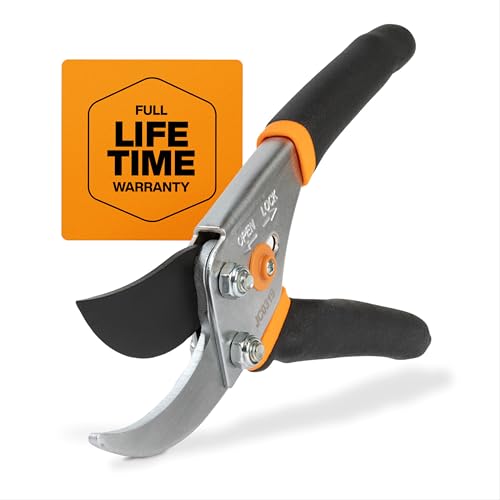
Fiskars Bypass Pruning Shears, 5/8" Cut Capacity Garden Clippers
Included for 'Best Bypass Pruning Shears for Clean Cuts' because the listing specifies 5/8" Cut Capacity Garden Clippers, details this guide uses to compare options.
View on Amazon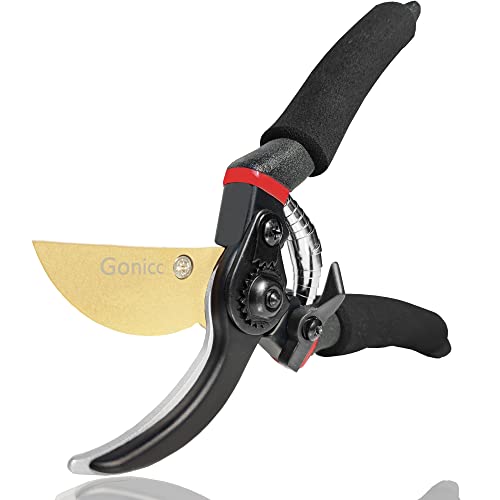
gonicc 8" Professional Premium Bypass Titanium Pruning Shears(GPPS-1003)
Included for 'Best Bypass Pruning Shears for Clean Cuts' as a relevant option in this category; details come from the product listing.
View on Amazon
Felco F2 Pruning Shears – 9.25" Swiss-Made Garden Clippers for Professional Pruning | Hand Pruners for Gardening | Garden Tool Cutter with Precision Bypass Blade, Aluminum Body, Replaceable Parts
Included for 'Best Bypass Pruning Shears for Clean Cuts' because the listing specifies 9.25" Swiss-Made Garden Clippers for Professional Pruning and Hand Pruners for Gardening, details this guide uses to compare options.
View on Amazon
Corona BP 3180D Forged Classic Bypass Pruner with 1" Cutting Capacity, 1", Red
Included for 'Best Bypass Pruning Shears for Clean Cuts' because the listing specifies Red, details this guide uses to compare options.
View on AmazonHow to Choose Bypass Pruning Shears: 5 Decision Criteria
1. Blade Material and Hardness
Blade steel determines edge retention, ease of sharpening, and corrosion resistance. Most quality shears use one of three classes:
- Hardened High-Carbon Steel: Found on Felco, ARS, and Okatsune models. Typically hardened to 55-60 HRC. Holds an edge longest and takes the finest edge, but requires oiling to prevent rust.
- SK-5 Carbon Steel: A Japanese high-carbon grade common on ARS and Kamaki shears. Similar hardness to high-carbon steel (58-60 HRC) with excellent toughness. Often coated with hard chrome or fluorine to reduce friction and sap adhesion.
- Stainless Steel or Coated Stainless: More rust-resistant and lower maintenance, but usually softer (52-55 HRC) and dulls faster. Common on entry-level Fiskars and Corona comfort models. A good pick for humid climates or if you rarely oil tools.
For the cleanest cuts, high-carbon and SK-5 will outperform stainless. Look for blades that are fully hardenable and replaceable — a replaceable blade extends tool life by years and is a sign of a professional-grade design. Non-stick coatings like PTFE or hard chrome help, but they wear off; the underlying steel matters more.
2. Cutting Capacity vs. Branch Size
Manufacturers list cutting capacity as the maximum diameter the shears can handle. Do not treat this as a target. Cutting at the limit requires excessive hand force and leaves a rougher cut.
- Up to 1/2 inch (12mm): Any compact bypass shear can handle this comfortably. Ideal for roses, herbs, and light perennial cleanup.
- 1/2 to 3/4 inch (12-19mm): The sweet spot for one-hand bypass pruners. This covers most fruit tree spur pruning, rose canes, and vine work. Choose a standard 8 to 8.5-inch shear.
- 3/4 to 1 inch (19-25mm): Maximum for hand pruners. Requires a long-handle, high-leverage model like the Felco 2 or ARS HP-VS8Z. Anything larger should move to loppers or a pruning saw to avoid hand strain and blade damage.
If you regularly cut wood near 1 inch, bypass pruners are the wrong tool — even if they can do it. You will get cleaner cuts and less fatigue from a 2-hand bypass lopper.
3. Handle Comfort and Ergonomics
Handle design matters more than weight for extended pruning sessions.
- Material: Forged aluminum handles (Felco, ARS) are rigid, lightweight, and transmit more cutting feel. Composite/fiberglass handles (Fiskars PowerGear) reduce vibration. Cushioned grips and rubber inserts reduce blisters but can feel bulky with gloves.
- Size and Hand Fit: One-hand pruners come in small, standard, and large sizes. Felco offers specific models for hand size (Felco 6 for small hands, Felco 2 for large hands). If your hand span from pinky to thumb is under 8 inches, avoid large-frame shears — you will not get full closure.
- Spring Type: Volute springs and cushion springs soften closure. Flat wire springs are durable and easy to replace. Avoid shears where the spring is not replaceable.
- Rotating Handles: Found on Felco 7 and 12. The handle rotates to reduce finger friction. Useful if you prune for hours or have arthritis, but adds cost and complexity.
4. Locking Mechanism
The lock keeps the shears closed in a pocket or sheath. Four common types:
- Wire Latch: Simple wire that flips over the blade. Durable and one-hand operable on models like the Felco 2.
- Sliding Lock / Thumb Lock: A slider on the handle. Quickest to operate, common on Fiskars and Corona.
- Rotating Latch: Twist to lock, seen on ARS HP series. Very secure but requires two fingers.
- Squeeze-to-Unlock: Squeeze handles and the lock releases. Fast but can accidentally open if brushed.
If you carry shears in a holster on a belt, a positive wire latch or rotating latch is safest. For quick one-hand use while harvesting, a thumb slide is faster.
5. Maintainability
A good bypass shear should be fully serviceable. Check for replacement blades, springs, and center bolts available from the manufacturer. Shears with a center bolt and anvil blade that can be adjusted for play stay tight longer and can be tuned as the blade wears. Riveted, non-adjustable shears cannot be tightened once they loosen and should be avoided for serious use.
Worked Calculation: How Leverage Determines Real Cutting Force
Spec sheets list capacity, but not how hard you have to squeeze. You can estimate cutting force with a simple leverage calculation.
Formula: Cutting Force = Hand Force x (Handle Length / Blade Pivot Distance)
Example comparison using two real 8-inch class shears:
- Shear A (standard): Handle length 110mm, pivot to cutting point 22mm. Leverage ratio = 5.0:1. If you apply 25 lbs of grip force, cutting force = 125 lbs at the blade.
- Shear B (high-leverage): Handle length 115mm, pivot to cutting point 18mm. Leverage ratio = 6.4:1. Same 25 lbs grip = 160 lbs cutting force — 28% more.
This is why a Felco 2 or Fiskars PowerGear feels easier on 3/4-inch wood than a compact shear with the same blade steel: the pivot is closer to the hand and the handles are longer. If you have reduced grip strength, prioritize leverage ratio over blade steel. If you make thousands of small cuts, a lower ratio with lighter handles causes less fatigue than maximum leverage.
Comparison Table: Popular Bypass Pruning Shears in 2026
| Model | Blade Steel / Hardness | Length | Claimed Capacity | Weight | Lock Type | General Market Price Range |
|---|---|---|---|---|---|---|
| Felco 2 | Hardened High-Carbon, Hard Chrome Coated / ~56 HRC | 8.5 in (216mm) | 1.0 in (25mm) | 8.4 oz (240g) | Wire Latch | usually $55–$75 |
| ARS HP-VS8Z | SK-5 High-Carbon, Hard Chrome Plated / ~59 HRC | 8.0 in (203mm) | 0.9 in (22mm) | 6.3 oz (180g) | Rotating Latch | usually $45–$65 |
| Okatsune 103 | Japanese Carbon Steel (IZUMO YASUGI) / ~59 HRC | 8.0 in (200mm) | 1.0 in (25mm) | 7.1 oz (200g) | Wire Latch | usually $45–$60 |
| Corona BP 3180 | High-Carbon Steel, PTFE Coated / ~55 HRC | 7.5 in (191mm) | 0.75 in (19mm) | 6.8 oz (193g) | Sliding Thumb Lock | usually $25–$40 |
| Fiskars Steel Bypass Pruner (P90) | Stainless Steel, Low-Friction Coating / ~54 HRC | 8.0 in (203mm) | 0.75 in (19mm) | 5.4 oz (154g) | Sliding Lock | usually $30–$45 |
Weights and capacities are manufacturer specs. Real-world capacity depends on wood hardness — dry oak at 3/4 inch requires far more force than green rose cane at the same diameter.
Decision Matrix: Which Shear Matches Your Situation
| If You Primarily Do… | Branch Size | Best Match | Why |
|---|---|---|---|
| Rose beds, perennials, deadheading | Under 1/2 in | Compact or small-hand model: ARS HP-VS7Z or Felco 6 | Smaller frame reduces hand fatigue for repetitive light cuts |
| Backyard fruit trees, grapes, shrubs | 1/2 to 3/4 in live wood | Standard full-size: Felco 2, ARS HP-VS8Z, Okatsune 103 | Optimal balance of leverage and control for live wood |
| Large shrubs, mature vines, woody canes | 3/4 to 1 in and mixed dead/live | High-leverage hand pruner + bypass lopper | Hand pruner for precision, lopper for anything over 3/4 in |
| Long sessions or limited hand strength | Variable | Rotating handle (Felco 7) or PowerGear-style Fiskars | Reduces required grip force by 20-30% via leverage/rotation |
| Humid climate or low maintenance | Under 3/4 in | Stainless or chrome-plated: Corona BP 3180 or Fiskars Steel | Corrosion resistance outweighs ultimate edge retention |
Getting Clean Cuts: Technique Matters More Than Price
Even the best shear will crush if used incorrectly.
- Cut at the branch collar: For live branches, cut just outside the swollen collar where the branch meets the trunk. Do not leave a stub and do not cut flush to the trunk.
- Keep the hook on the waste side: The thin cutting blade should be on the plant side — the side you want to keep. The thicker hook acts as an anvil and can slightly bruise the waste side.
- Make one committed cut: Do not half-squeeze and twist. A single decisive closure shears fibers cleanly.
- Sharpen at the original bevel: Most bypass blades have a 20 to 23-degree bevel. Hone only the outside bevel with a diamond file or whetstone, then remove the burr from the flat inside face. Oiling the pivot and cleaning sap with isopropyl alcohol after each session prevents sticking and disease transfer.
- Tighten the center bolt: If you see daylight between the blades when closed or the cut folds tissue instead of slicing, tighten the center bolt 1/8 turn until the blades pass with light friction, no gap.
When Not to Use Bypass Shears
Do not use bypass pruners to cut wire, open bags, or trim dead hardwood over 1 inch — you will notch or spring the blade. For dead wood, switch to an anvil pruner or lopper where crushing does not matter. For hedges, use hedge shears; bypass pruners are too slow and leave uneven finishes.
FAQ
Do I need left-handed bypass shears? True left-handed shears like the Felco 9 are mirror-imaged so the cutting blade is on the left side. If you are left-handed and make many precise cuts, they give better sightlines. Otherwise standard shears work with either hand, you just flip how you orient the waste side.
How often should I sharpen? For home use, hone the edge lightly every 2-4 hours of cutting time, or whenever you notice you are squeezing harder or leaves are torn rather than cut. A full sharpening with a file is typically needed once or twice per season if you clean blades regularly.
Are titanium-coated blades better? Titanium nitride coatings reduce friction and look premium, but they do not make the steel harder. Edge performance comes from the base steel and heat treatment. View coatings as a bonus, not a deciding factor.
