Key takeaways
- Move food to another freezer or insulated coolers before switching the unit off.
- Unplug the freezer and open the drain plug if the model has one.
- Place towels around the cabinet and use containers for meltwater.
- Let ice soften naturally; do not use a knife, screwdriver, heat gun, or open flame.
- Dry the interior completely, restore power, and let the freezer return to 0°F before reloading food.
The best chest freezers for most homes are a 7–10 cubic-foot model for everyday overflow, while a 14–16 cubic-foot freezer is the better choice for bulk meat, garden produce, or a large household; the right pick depends as much on usable floor space and garage temperature as on capacity.
Best chest freezers at a glance
| Best for | Useful capacity | Typical footprint | Typical annual energy use | What to prioritize |
|---|---|---|---|---|
| Small apartment or occasional backup | 3.5–5 cu. ft. | 30–36 in. wide × 20–25 in. deep | 180–260 kWh | Compact dimensions, removable basket, quiet operation |
| Most households | 7–10 cu. ft. | 34–42 in. wide × 22–28 in. deep | 200–320 kWh | Stable thermostat, two baskets, garage-ready operation |
| Bulk shopping or family storage | 14–16 cu. ft. | 48–57 in. wide × 26–33 in. deep | 300–450 kWh | Thick insulation, interior light, multiple baskets, drain plug |
| Large-scale food storage | 18–22 cu. ft. | 60–73 in. wide × 30–35 in. deep | 380–550 kWh | Dedicated circuit planning, strong lid hardware, organization system |
Energy figures are useful comparison ranges rather than guarantees. Actual consumption depends on room temperature, how often the lid is opened, the amount of unfrozen food added, and whether the freezer is installed with adequate clearance.

Midea 3.5 Cu.ft Chest Freezer, Fridge Freezer Convertible with LED Light
Included for 'Best Chest Freezers for Home and Garage' because the listing specifies Fridge Freezer Convertible with LED Light, details this guide uses to compare options.
View on Amazon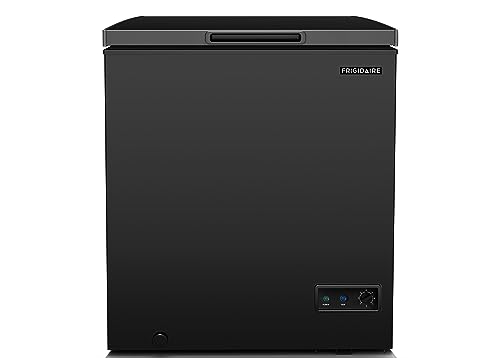
FRIGIDAIRE EFRF5003-BLACK Chest Deep Freezer-Garage-Ready, 5.0 Cu. Ft. Capacity, Black-Adjustable Thermostat-Removable Vinyl Coated Wire Basket-Easy Defrost Drain
Included for 'Best Chest Freezers for Home and Garage' because the listing specifies 5.0 Cu. Ft. Capacity, details this guide uses to compare options.
View on Amazon
Hamilton Beach 17 cu ft Chest Deep Freezer - White, GARAGE READY Food for Large Family, Storage Basket, Space-Saving Flat Back, Stay-Open Lid, Front-Access Drain, for Basement, Laundry Room, Cottage
Included for 'Best Chest Freezers for Home and Garage' because the listing specifies White and GARAGE READY Food for Large Family, details this guide uses to compare options.
View on Amazon
14 cu ft Chest Freezer - White, Large Storage for Families, Space-Saving Flat Back, Front Drain, Garage Ready - By Hamilton Beach
Included for 'Best Chest Freezers for Home and Garage' because the listing specifies White and Large Storage for Families, details this guide uses to compare options.
View on AmazonOur main recommendation: a 7–10 cu. ft. garage-ready chest freezer
A mid-size chest freezer is usually the best balance of capacity, price, footprint, and manageability. Models such as the GE FCM7SKWW, GE FCM10SRWW, and comparable Frigidaire or Midea 7–10 cu. ft. units fit enough food for bulk purchases without turning a garage into a storage project.
Seven cubic feet is suitable for a couple or small family that mainly stores frozen meals, meat, and occasional overflow. Ten cubic feet gives noticeably more room for boxed food and larger packages, but it also becomes harder to search without baskets or labeled bins.
Look for at least one sliding wire basket, an adjustable mechanical thermostat, a power-on indicator, and a drain plug for defrosting. A lock is useful if children have access to the garage, although it should not be treated as a substitute for child-safe installation.
Head-to-head: compact, mid-size, and large models
Compact chest freezers: 3.5–5 cubic feet
A compact freezer, including models in the Danby 3.5 cu. ft. class, works well for a basement, apartment, dorm-style utility area, or a household that wants a small emergency reserve. It can fit under or beside a work surface, but measure the lid’s opening arc before buying; a freezer that fits its floor position may still be blocked by shelving above it.
The limitation is organization. Compact units often have one basket, and the basket occupies a significant share of the accessible space. They are best when you store a predictable mix of items rather than deep inventories of frozen meat.
Mid-size chest freezers: 7–10 cubic feet
This is the strongest all-purpose category. The GE FCM7SKWW is a well-known 7.0 cu. ft. example, while 10–11 cu. ft. models provide more room without requiring the long wall space of a full-size freezer.
Choose a two-basket layout if you frequently separate breakfast foods, prepared meals, and raw ingredients. A single large basket can be better for irregularly shaped packages, but it encourages a “top layer over buried food” problem. Wire baskets are easier to lift out; solid plastic bins contain small packages better but can reduce airflow around the stored food.
Large chest freezers: 14–16 cubic feet
Large models such as the Frigidaire FFFC15M4TW class are appropriate for families, hunters, gardeners, and people who buy meat in bulk. Their long, wide cabinets generally offer better packing efficiency than several small freezers, but only if you create zones with removable baskets or labeled freezer bins.
Before choosing one, check the route into the garage or basement. Door openings, stair turns, and the freezer’s actual shipping dimensions can matter more than the listed cabinet dimensions. A 15 cu. ft. unit may need nearly five feet of unobstructed wall width and enough clearance to open its lid fully.
Garage readiness matters more than the label
“Garage ready” usually means the freezer is designed to operate across a wider ambient-temperature range than a basic indoor model. That matters in an unheated garage, where winter temperatures can fall low enough to affect the thermostat and summer temperatures can force the compressor to run for long periods.
Do not assume every chest freezer is garage ready. Confirm the manufacturer’s stated operating range, then compare it with your actual garage temperature. A hot garage can also raise energy use and shorten compressor life. Keep the cabinet away from direct sun, water heaters, furnaces, and car exhaust, and leave the clearance specified in the manual around the condenser area.
A freezer placed on an uneven garage floor may have a lid that does not seal consistently. Use a level rather than relying on the appearance of the floor. Check the gasket with a sheet of paper: close the lid on it at several points. If the paper slides out without resistance, inspect the gasket for damage or a twisted lid before adjusting the temperature.
Temperature stability and controls
The target for frozen food is 0°F (-18°C) or below. The best chest freezers do not need to be set to their coldest position; a stable setting near the middle of the control range is often more efficient and reduces unnecessary temperature swings.
Mechanical dials are simple and reliable, but their numbered settings are not temperatures. Use a separate freezer thermometer during the first week. Place it near the center of the food load, not against the wall or directly under the lid, and check it after the freezer has been closed for several hours.
If the reading is warmer than 0°F, lower the setting one step and wait 12–24 hours before making another change. Adding a large quantity of unfrozen food temporarily raises the temperature, so avoid judging performance immediately after a big grocery trip. An interior light is a small but valuable feature in a dark garage, particularly on wide models.
Manual defrost: inconvenient, but often practical
Most chest freezers use manual defrost. Ice buildup acts as insulation between the cold interior and the food, reduces usable space, and can prevent the lid from sealing. Defrost when ice reaches roughly 1/4 inch thick rather than waiting until the basket is difficult to remove.
- Move food to another freezer or insulated coolers before switching the unit off.
- Unplug the freezer and open the drain plug if the model has one.
- Place towels around the cabinet and use containers for meltwater.
- Let ice soften naturally; do not use a knife, screwdriver, heat gun, or open flame.
- Dry the interior completely, restore power, and let the freezer return to 0°F before reloading food.
Manual defrost is the reason chest freezers can be relatively efficient and inexpensive. Frost-free designs are more convenient, but their fans and heating cycles can increase energy use and add mechanical complexity.
Worked energy-cost calculation
Suppose a mid-size freezer uses 280 kWh per year and your electricity rate is $0.18 per kWh:
280 kWh × $0.18 = $50.40 per year
At the same rate, a 450 kWh large freezer would cost about $81 per year. The difference is approximately $31 annually, so buying a smaller freezer solely to save electricity may not make sense if it forces you to run a second unit. Compare the combined consumption of multiple small freezers with one larger, well-organized model.
Decision matrix: which freezer fits your situation?
| Your situation | Recommended class | Why | Important warning |
|---|---|---|---|
| Apartment, limited floor space | 3.5–5 cu. ft. | Lowest footprint and manageable capacity | Confirm lid clearance and noise expectations |
| Family storing weekly overflow | 7–10 cu. ft. | Good balance of access, cost, and storage | Prefer two baskets or add labeled bins |
| Unheated garage with seasonal extremes | Garage-ready 7–16 cu. ft. | Designed for a broader ambient range | Verify the published temperature range |
| Bulk meat or garden harvest | 14–22 cu. ft. | More efficient than operating several small units | Measure delivery path and plan organization |
| Infrequent use or emergency backup | 5–7 cu. ft. | Enough reserve without excessive idle capacity | Keep it at least partly full for better thermal stability |
What to check before buying
- Measure the installation space: include lid clearance, wall clearance, and room to stand in front while lifting baskets.
- Check the electrical supply: use a properly grounded outlet and avoid sharing a lightweight extension cord with other high-draw appliances.
- Compare usable organization: capacity figures do not tell you how many baskets fit or whether they can be removed easily.
- Look for a drain plug: it makes manual defrosting substantially less messy.
- Confirm the temperature range: especially for a garage, shed, porch, or basement.
- Budget for a thermometer: it is the only practical way to verify that the freezer is maintaining a safe temperature.
For most buyers, a garage-ready 7–10 cu. ft. chest freezer with two baskets, a drain plug, a power indicator, and a reliable mechanical thermostat is the best overall choice. Go compact when floor space is the priority, and move to 14–16 cu. ft. only when your storage needs justify the larger footprint and the extra work of organizing it.