
Key takeaways
- Foam-core blankets: A durable choice for repeated use when the foam is protected by tough, sewn or welded outer layers. Inspect seams and punctures; damaged covers can admit water and reduce insulation.
- Quilted or fiber-filled blankets: Often flexible and easy to fold over irregular edges. Confirm that the fill stays dry and that the outer fabric resists water and abrasion.
- Reflective-faced blankets: Can help reduce radiant heat loss, but the reflective layer does not replace insulation. Follow the manufacturer’s instructions for which side faces the concrete and how to secure seams.
- Disposable insulating covers: Useful for a one-off pour or where transport and storage are difficult. They may be less robust for repeated handling and should be secured against wind.
Best Concrete Curing Blankets for Cold Weather Pours
The best concrete curing blankets for cold-weather pours are insulated, water-resistant blankets sized to cover the entire slab with overlap; choose their insulation rating and thickness according to the expected overnight low, slab geometry, and whether the concrete will be exposed for one night or several. For most residential flatwork, a reusable blanket rated around R-5 to R-7 is a practical starting point, but it is not a substitute for checking concrete temperature and following the mix designer’s cold-weather requirements.
Choose by conditions, not thickness alone
Blanket labels may state an R-value, thickness, or both. R-value is the more useful comparison when it is available: it indicates resistance to heat flow, and a higher value generally slows heat loss more. Thickness is only a rough clue because insulation material, compression, seams, and construction also affect performance. Two blankets of equal thickness can insulate differently.

Moose Supply Concrete Curing Blanket 12x24 Winter Heavy Duty Insulated Tarp
Included for 'Best Concrete Curing Blankets for Cold Weather' as a relevant option in this category; details come from the product listing.
View on Amazon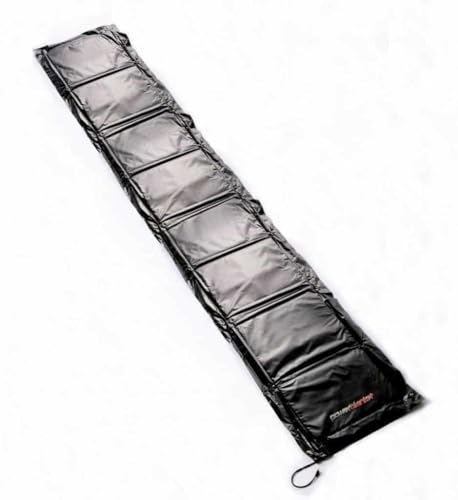
Powerblanket MD0304 Heated Concrete Blanket - 3' x 4' Heated Dimensions - 4' x 5' Finished Dimensions
Included for 'Best Concrete Curing Blankets for Cold Weather' because the listing specifies 3' x 4' Heated Dimensions and 4' x 5' Finished Dimensions, details this guide uses to compare options.
View on Amazon
Sandbaggy Concrete Blankets Insulated 6 ft x25 ft with Grommets (max R-Value 3.35) - Waterproof, UV Resistant - Concrete Curing Tarp, Cement (2, 6 ft x 25 ft)
Included for 'Best Concrete Curing Blankets for Cold Weather' because the listing specifies Waterproof and UV Resistant, details this guide uses to compare options.
View on Amazon
Powerblanket MD0310G Xtreme Gray Alloy Heated Concrete Blanket - 3' x 10' Heated Dimensions - 4' x 11' Finished Dimensions
Included for 'Best Concrete Curing Blankets for Cold Weather' because the listing specifies 3' x 10' Heated Dimensions and 4' x 11' Finished Dimensions, details this guide uses to compare options.
View on AmazonUse the table as a planning guide, not a guarantee. Wind, moisture, edge exposure, concrete temperature at placement, and the slab’s thickness all change how quickly a pour cools. Follow the blanket manufacturer’s stated operating range and the project specifications.
| Expected overnight low | Typical blanket class to consider | Where it may fit | Key caution |
|---|---|---|---|
| Above 40°F (4°C) | Light insulation, roughly R-2 to R-4 | Short protection period for a small, sheltered slab | Unprotected edges can still cool quickly. |
| 20–40°F (-7 to 4°C) | Medium insulation, roughly R-5 to R-7 | Common residential slabs with overnight protection | Check the forecast for wind and consecutive cold nights. |
| Below 20°F (-7°C) | Higher insulation, often R-7 or above, plus a cold-weather plan | Longer protection or more exposed work | A blanket alone may not maintain the required concrete temperature. |
These ranges are screening guidance, not design limits. A thin walkway loses heat faster than a thick footing, while corners and slab edges lose heat faster than the middle. If the forecast approaches the mix or project’s minimum temperature limits, consult the concrete supplier or engineer about heated enclosures, approved accelerating admixtures, or other controls rather than simply stacking blankets.
Match blanket construction to the job
- Foam-core blankets: A durable choice for repeated use when the foam is protected by tough, sewn or welded outer layers. Inspect seams and punctures; damaged covers can admit water and reduce insulation.
- Quilted or fiber-filled blankets: Often flexible and easy to fold over irregular edges. Confirm that the fill stays dry and that the outer fabric resists water and abrasion.
- Reflective-faced blankets: Can help reduce radiant heat loss, but the reflective layer does not replace insulation. Follow the manufacturer’s instructions for which side faces the concrete and how to secure seams.
- Disposable insulating covers: Useful for a one-off pour or where transport and storage are difficult. They may be less robust for repeated handling and should be secured against wind.
For reuse, prioritize reinforced edges, repairable covers, secure tie points, and a stated cleaning and storage method. A water-resistant exterior helps shed rain or snow, but “water-resistant” does not necessarily mean waterproof. Keep blankets from sitting in standing water, and dry them before storage to limit deterioration and mold.
Calculate coverage before ordering
Measure the slab, then include enough material to protect the perimeter and overlap neighboring blankets. For a rectangular slab, a quick estimate is:
Blanket coverage target = (slab length + 2 × edge allowance) × (slab width + 2 × edge allowance)
For example, a 20-by-30-foot slab with a 1-foot allowance on every side needs a coverage footprint of 22 × 32 = 704 square feet. If individual blankets are 6 × 25 feet (150 square feet each), four blankets provide 600 square feet and are short; five provide 750 square feet before accounting for overlap. Plan the layout so seams overlap by about 6–12 inches, if the manufacturer permits, and so the perimeter is not left exposed.
This estimate is deliberately conservative: overlaps consume usable area. Sketch the layout before buying, especially around steps, corners, anchor bolts, or narrow extensions. Secure the edges with suitable weights or fasteners without damaging the blanket or creating trip hazards.
A practical selection matrix
| Your situation | What to prioritize | Reason |
|---|---|---|
| One small pour, mild frost risk | Easy handling, adequate coverage, water-resistant face | Convenience and full edge coverage may matter more than maximum insulation. |
| Repeated residential work | Mid-to-high R-value, reinforced seams, repairable outer layer | Durability and dry storage make reuse more dependable. |
| Large or exposed slab | Higher insulation, secure attachment points, enough units for overlap | Wind and perimeter losses can defeat an undersized or poorly secured cover. |
| Very low temperatures or critical structural work | Specified thermal protection plan and temperature monitoring | Blanket selection alone cannot verify curing conditions or strength development. |
Use blankets without trapping a problem
Place blankets promptly after finishing, once the surface can tolerate covering without being marred. Keep the cover continuous and secure it against wind, while avoiding direct contact that could damage a vulnerable finish. Do not use a blanket to conceal a pour that has already frozen or to assume the concrete has reached a particular strength.
Monitor the concrete temperature where the project requires it, particularly near edges and corners. A surface reading in the center may not represent the coldest area. Avoid repeatedly lifting covers to inspect the slab; each opening releases heat. If checks are necessary, use a planned access point and reseal it promptly.
When removing protection, avoid an abrupt temperature change. Gradually uncover the concrete when conditions allow, following the project specification and applicable cold-weather concrete guidance. Keep protection in place for the required period; the number of nights alone does not prove that the concrete has gained sufficient strength.
Bottom line
For a typical residential pour facing freezing nights, start by comparing blankets around R-5 to R-7, then adjust for the slab’s thickness, exposure, forecast lows, and duration of protection. Verify the actual R-value and temperature guidance, buy enough area for overlap and edges, and favor water-resistant, reinforced construction if you expect to reuse the blankets. In severe cold or critical work, pair the blanket with a monitored cold-weather plan rather than relying on insulation alone.
