Key takeaways
- You want 1440p capability without paying for a higher-tier GPU.
- You keep graphics cards for four or more years.
- You play texture-heavy games or use high-resolution texture packs.
- You care more about conventional rasterized performance than ray tracing.
The best budget graphics cards and GPUs in 2026 are the Radeon RX 9060 XT 16GB for long-term 1440p value, the GeForce RTX 5060 for efficient 1080p gaming, and Intel Arc B580 for affordable VRAM capacity—while the RTX 5060 Ti 16GB is the stronger all-round upgrade if you can spend more.
Best budget graphics cards and GPUs in 2026 at a glance
| GPU | Typical market range | VRAM | Board power | Best target | Ray tracing |
|---|---|---|---|---|---|
| Radeon RX 9060 XT | Usually $300–$400, depending on version | 8GB or 16GB GDDR6 | About 160W | 1080p ultra or 1440p high | Playable, but not its main strength |
| GeForce RTX 5060 Ti | Usually $380–$500 | 8GB or 16GB GDDR7 | About 180W | 1440p with upscaling | Strong for its class |
| GeForce RTX 5060 | Usually $300–$370 | 8GB GDDR7 | About 145W | 1080p high or ultra | Good with DLSS and frame generation |
| Intel Arc B580 | Usually $250–$330 | 12GB GDDR6 | About 190W | 1080p and entry-level 1440p | Usable, though less consistent than Nvidia |
| Intel Arc B570 | Usually $220–$290 | 10GB GDDR6 | About 150W | 1080p high | Acceptable with sensible settings |
| GeForce RTX 4060 | Usually $270–$350 where stock remains | 8GB GDDR6 | About 115W | 1080p in a low-power PC | Good, but weaker long-term value |
Prices vary by country, cooler design and availability. The important comparison is not only average frame rate: VRAM capacity, power draw, upscaling support and the cost of the rest of your system can change which card is actually the best buy.

GIGABYTE GeForce RTX 3050 WINDFORCE OC V2 6G Graphics Card, 2X WINDFORCE Fans, 6GB GDDR6 96-bit GDDR6, GV-N3050WF2OCV2-6GD Graphics Card
Included for 'Best Budget Graphics Cards and GPUs in 2026' because the listing specifies 2X WINDFORCE Fans and 6GB GDDR6 96-bit GDDR6, details this guide uses to compare options.
View on Amazon
ASUS Dual GeForce RTX 3050 6GB GDDR6 OC Edition Gaming Graphics Card
Included for 'Best Budget Graphics Cards and GPUs in 2026' as a relevant option in this category; details come from the product listing.
View on Amazon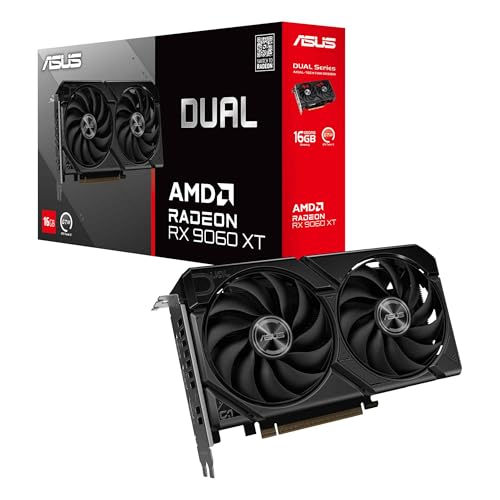
ASUS Dual Radeon RX 9060 XT 16GB GDDR6 Gaming Graphics Card
Included for 'Best Budget Graphics Cards and GPUs in 2026' as a relevant option in this category; details come from the product listing.
View on Amazon1. Radeon RX 9060 XT 16GB: best overall budget choice
The 16GB Radeon RX 9060 XT is the strongest value choice for many players who want one card for both 1080p and 1440p. Its large memory buffer gives it more room for high-resolution textures and future games than an 8GB card, and its power requirement is manageable in a mainstream desktop.
At 1080p, it is suitable for high or ultra settings in most conventional games. At 1440p, it generally makes more sense to use high rather than maximum settings, particularly in demanding open-world releases. Ray tracing is available, but if RT is a priority, Nvidia’s software and hardware features usually justify considering the RTX 5060 Ti instead.
Choose the RX 9060 XT 16GB if:
- You want 1440p capability without paying for a higher-tier GPU.
- You keep graphics cards for four or more years.
- You play texture-heavy games or use high-resolution texture packs.
- You care more about conventional rasterized performance than ray tracing.
The 8GB model can be reasonable when it is substantially cheaper and your display is 1080p, but the 16GB version offers better upgrade value. Avoid paying a small premium for an 8GB card when a 16GB model is close in price.
2. GeForce RTX 5060 Ti 16GB: best for ray tracing and mixed workloads
The RTX 5060 Ti 16GB is the more versatile option for buyers who want ray tracing, upscaling and strong creator support alongside gaming. DLSS can reduce the performance cost of demanding effects, and the card is a better fit than most budget Radeon models for games where path tracing or heavy ray tracing is central to the experience.
It targets 1440p gaming, although demanding titles may still need a quality upscaling mode. The 16GB version is preferable for this resolution because ray-traced games can consume memory quickly when high-quality textures, shadows and large environments are combined.
The 8GB RTX 5060 Ti is harder to recommend unless the discount is significant. It can be fast enough today, but its memory capacity can force texture reductions sooner than its raw GPU performance would suggest.
Why the RTX 5060 Ti can be worth the extra money
- More consistent ray-tracing performance than similarly priced alternatives.
- DLSS support can improve image quality and frame rates at 1440p.
- Excellent efficiency for a card in this performance range.
- 16GB models are better suited to long-term use than most 8GB alternatives.
It is not automatically the best value: if you never enable ray tracing and the RX 9060 XT 16GB is much cheaper, the Radeon card may deliver more conventional performance per dollar.
3. GeForce RTX 5060: best efficient 1080p GPU
The RTX 5060 is a sensible choice for a compact or modest-power gaming PC. Its approximately 145W board power is easy for a quality 550W power supply to support, and it provides a strong 1080p experience with modern upscaling and frame-generation features.
Its main weakness is the 8GB VRAM limit. That is still workable for 1080p, but you may need to lower textures, shadows or ray-traced effects in newer games. The right approach is to preserve texture quality where possible, then reduce the settings that consume the most GPU memory and have the smallest visible effect.
Recommended RTX 5060 starting settings
- Resolution: native 1080p.
- Preset: high, then lower volumetric effects and screen-space reflections if necessary.
- Ray tracing: off or medium unless the game has a particularly efficient implementation.
- Upscaling: quality mode when the frame rate falls below your monitor’s target.
- Texture quality: high, but reduce it to medium if the game reports VRAM pressure or shows stuttering.
For a 1080p 144Hz monitor, this card is a better match than a 1440p-focused GPU if your budget is limited and competitive games are your priority.
4. Intel Arc B580: best low-cost VRAM capacity
The Arc B580 stands out with 12GB of VRAM at a relatively low price. That makes it attractive for players who want more memory than typical entry-level Nvidia cards without moving into a more expensive class.
It is particularly appealing for 1080p high settings and entry-level 1440p. However, Intel Arc performance can depend more heavily on game support and driver maturity than Nvidia or AMD alternatives. Modern games using current graphics APIs tend to be the safest target; older games may show less predictable results.
Check that your system has Resizable BAR enabled. Arc cards depend on it for proper performance, and an older motherboard or unsupported processor can make the B580 a poor choice even if the graphics card itself is inexpensive. A quality 600W power supply is a sensible pairing because the card uses more power than the RTX 5060.
5. Intel Arc B570: the budget 1080p alternative
The Arc B570 is worth considering when the purchase price matters more than maximum frame rate. Its 10GB memory capacity is useful at 1080p, and it can outperform what its price suggests in newer games. The trade-offs are higher power consumption than the RTX 5060 and greater sensitivity to system configuration.
Choose it over an 8GB rival when the price is clearly lower or when you want extra VRAM for texture-heavy games. Choose the RTX 5060 instead if you have a small power supply, a compact case or a large library of older PC games.
How much GPU power and VRAM do you actually need?
A useful rule is to match memory to resolution and expected ownership period:
- 1080p for two to three years: 8GB is usable, though not ideal for every new release.
- 1080p for four or more years: 10GB or 12GB provides more comfort.
- 1440p: 12GB is a sensible minimum for a new purchase; 16GB is preferable.
- 4K: budget GPUs are generally unsuitable unless you accept aggressive upscaling and reduced settings.
Resolution also affects the amount of work per frame. A 1440p image contains about 3.7 million pixels, compared with about 2.1 million at 1080p. That is roughly 1.78 times as many pixels. If a card renders a game at 100 frames per second at 1080p, the same settings could require about 1.78 times the shading work at 1440p, before accounting for different memory and CPU behavior. This is why a card that feels excellent at 1080p may need upscaling or reduced settings at 1440p.
Decision matrix: which budget GPU fits your PC?
| Your situation | Best fit | Reason |
|---|---|---|
| Small case or 550W power supply | RTX 5060 | Low power draw and strong 1080p performance |
| 1440p monitor and long ownership period | RX 9060 XT 16GB | Good raster performance and useful VRAM headroom |
| Ray tracing is a major priority | RTX 5060 Ti 16GB | Better RT ecosystem and upscaling support |
| Lowest price with more than 8GB VRAM | Arc B580 | 12GB capacity at an entry-level price |
| Mostly esports at 1080p | RTX 5060 or Arc B570 | Enough performance without paying for a 1440p card |
| Older motherboard or many older games | RTX 5060 or RX 9060 XT | Fewer platform and API compatibility concerns than Arc |
Power supply and upgrade value
Do not calculate the power supply from the GPU’s board rating alone. For example, a 145W RTX 5060 paired with a 105W processor, 60W for the motherboard, drives and fans, and a 25% safety margin comes to:
(145W + 105W + 60W) × 1.25 = 387.5W.
A quality 500W unit may therefore be electrically adequate, but 550W gives more practical headroom for transient loads and future upgrades. For an Arc B580 using approximately 190W, the same system calculation becomes about 444W, making a quality 600W supply the more comfortable choice.
Also check the physical card length, thickness, auxiliary power connector and airflow. A cheap GPU that requires a new power supply or case fans may no longer be the cheapest upgrade.
What to buy
For most buyers, the RX 9060 XT 16GB is the best budget graphics card when 1440p and longevity matter. Choose the RTX 5060 Ti 16GB instead for stronger ray tracing and Nvidia’s software features. The RTX 5060 is the efficient 1080p pick, while Intel’s Arc B580 is the value alternative for buyers who prioritize VRAM and accept more platform sensitivity.
Whichever model you choose, compare the 16GB or 12GB version against the 8GB version at the actual sale price. A small premium for additional memory can extend the useful life of the card, but a large premium may be better spent on a faster GPU tier or a higher-refresh monitor.