Key takeaways
- Birds in flight: begin at 1/2000 second, f/5.6 to f/8, Auto ISO, animal or bird detection, and a 10–20-fps burst.
- Fast mammals: use 1/1000 to 1/2000 second, continuous autofocus, and a flexible tracking zone. Increase shutter speed if paws or wings remain blurred.
- Perched birds or resting animals: try 1/500 to 1/1000 second and reduce the burst rate. This preserves battery and card space while allowing time to recompose.
- Low light: open the lens fully, set a minimum shutter speed, and accept a higher ISO before lowering shutter speed enough to introduce subject movement.
- Backlit subjects: expose for the animal rather than the bright sky, then protect highlights if shooting RAW. Spot metering can help, but confirm exposure with the histogram.
The best camera for wildlife photography in 2026 is the Canon EOS R5 Mark II for demanding full-frame work, while the Canon EOS R7, Nikon Z8, Sony Alpha 1 II, OM System OM-1 Mark II, and Fujifilm X-H2S each make a stronger choice for particular combinations of reach, speed, subject tracking, and field portability.
Quick comparison: the best wildlife cameras
| Camera | Sensor and resolution | Continuous shooting | Best advantage | Approximate body weight | Typical body price range |
|---|---|---|---|---|---|
| Canon EOS R5 Mark II | 45MP full frame, stacked | Up to 30 fps electronic | High-resolution action and excellent subject detection | About 746g | Usually $3,800–$4,300 |
| Nikon Z8 | 45.7MP full frame, stacked | Up to 20 fps RAW; faster JPEG modes | Detailed files, deep autofocus controls, strong crop flexibility | About 910g | Usually $3,500–$4,000 |
| Sony Alpha 1 II | 50.1MP full frame, stacked | Up to 30 fps electronic | Resolution and speed in one body | About 743g | Usually $6,000–$6,500 |
| Canon EOS R7 | 32.5MP APS-C | Up to 30 fps electronic | Reach, value, and manageable weight | About 612g | Usually $1,300–$1,600 |
| Fujifilm X-H2S | 26.1MP APS-C, stacked | Up to 40 fps electronic | Very fast bursts and strong video capability | About 660g | Usually $1,800–$2,200 |
| OM System OM-1 Mark II | 20.4MP Micro Four Thirds, stacked | Up to 50 fps with continuous autofocus | Small lenses, weather sealing, and field mobility | About 599g | Usually $1,900–$2,300 |
Best overall: Canon EOS R5 Mark II
The Canon EOS R5 Mark II is the most balanced choice for wildlife photographers who want high resolution without giving up fast electronic shooting. Its 45-megapixel full-frame sensor leaves room to crop a distant animal, while its stacked design reduces the rolling-shutter distortion that can make flying birds or running mammals look unnaturally bent.

Canon EOS Rebel T7 DSLR Camera Double Zoom Lens Kit
Included for 'Best Cameras for Wildlife Photography' as a relevant option in this category; details come from the product listing.
View on Amazon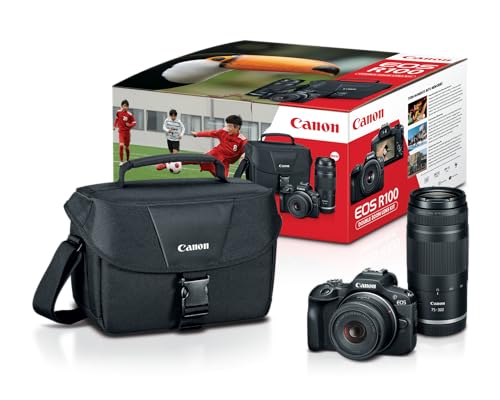
Canon EOS R100 Double Zoom Lens Kit, Black
Included for 'Best Cameras for Wildlife Photography' because the listing specifies Black, details this guide uses to compare options.
View on Amazon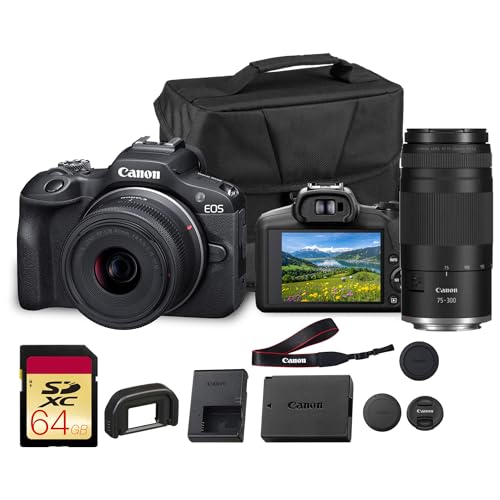
Canon EOS R100 Mirrorless Camera with 18-45mm & 75-300mm Double Lens Bundle
Included for 'Best Cameras for Wildlife Photography' as a relevant option in this category; details come from the product listing.
View on Amazon
Nikon COOLPIX P1100 Superzoom Digital Camera | 125x Optical Zoom with Image Stabilization 16 MP 4K Ultra HD Video Wi-Fi Connectivity RAW Format and Rotating LCD Screen (Black)
Included for 'Best Cameras for Wildlife Photography' as a relevant option in this category; details come from the product listing.
View on AmazonCanon’s animal-detection autofocus can identify eyes and bodies across birds, mammals, and other subjects. The camera is particularly useful when the background is cluttered, because subject tracking can continue after the animal briefly passes behind grass, branches, or another subject. The main compromise is storage: large RAW files and 30-fps bursts require fast, high-capacity cards and disciplined culling.
Best for maximum detail: Nikon Z8
The Nikon Z8 is a strong alternative for photographers who prioritize image detail, cropping latitude, and extensive autofocus customization. Its 45.7-megapixel sensor produces files with enough resolution for large prints or aggressive crops, and Nikon’s 3D tracking and animal detection are effective for birds and mammals when the photographer selects an appropriate subject mode.
The Z8 does not have a built-in mechanical shutter, so electronic-shutter technique matters with fast lateral movement. Its body is also heavier than the Canon R7 or OM-1 Mark II, but the trade-off is a professional control layout, a large grip, and excellent compatibility with Nikon’s long Z-mount lenses.
Best premium hybrid of speed and resolution: Sony Alpha 1 II
The Sony Alpha 1 II is designed for photographers who need both 50-megapixel files and 30-fps bursts. Its stacked full-frame sensor, sophisticated subject recognition, and blackout-minimized electronic viewfinder make it especially attractive for fast birds, motorsport-style wildlife action, and unpredictable movement.
The price is its biggest limitation. It makes sense when one camera must cover wildlife, sports, and high-resolution editorial work. For a dedicated wildlife kit, the Canon EOS R5 Mark II or Nikon Z8 may leave more of the budget available for a long telephoto lens, which often improves results more than a small difference in camera specifications.
Best value and reach: Canon EOS R7
The Canon EOS R7 is one of the best cameras for wildlife photography when distance, budget, and carrying weight matter more than full-frame high-ISO performance. Its APS-C sensor gives lenses a narrower field of view than they have on full frame: a 500mm lens frames like an approximately 800mm lens in equivalent field of view.
That is not extra optical magnification, but it does place more pixels on a distant subject when the lens and camera have similar resolution. The R7 also offers up to 30-fps electronic shooting and reliable animal autofocus. At dawn or dusk, however, its smaller sensor generally shows more noise than the full-frame cameras above at comparable exposure settings.
Best for small, fast field kits: OM System OM-1 Mark II
The OM-1 Mark II is the practical choice for photographers who spend entire days hiking, working in wet conditions, or carrying multiple lenses. Its Micro Four Thirds sensor produces a 2x field-of-view factor, so a 300mm lens frames similarly to a 600mm lens on full frame. OM System’s compact telephoto lenses make that reach far easier to carry.
Its stacked sensor supports very fast continuous autofocus bursts, and the body has excellent weather resistance when paired with suitably sealed lenses. The compromise is lower resolution and less clean high-ISO performance than the larger-sensor alternatives. It is strongest in good daylight, woodland conditions where portability matters, and situations where a lighter 600mm-equivalent kit increases the chance of being ready when an animal appears.
Best for extreme burst speed: Fujifilm X-H2S
The Fujifilm X-H2S combines a stacked APS-C sensor with bursts of up to 40 frames per second using its electronic shutter. It is a compelling option for birds in flight, rapid wingbeats, and animals changing direction quickly. Its 26.1-megapixel files are large enough for many publications while remaining easier to store than 45- or 50-megapixel RAW files.
Fujifilm’s X-mount offers several useful wildlife lenses, including long zooms and bright telephoto primes. Autofocus performance depends heavily on firmware, subject mode, shutter speed, and the contrast of the animal against its background, so careful configuration is more important than simply selecting the highest frame rate.
Autofocus, burst speed, and sensor performance: what matters in practice
Autofocus tracking
Animal detection is most useful when it identifies the eye and keeps tracking after the subject moves. It is not a substitute for positioning the autofocus area correctly. For birds in flight, use animal or bird detection with a tracking zone rather than a tiny single point; for an animal partly hidden in vegetation, a smaller flexible zone can prevent the camera from locking onto foreground branches.
Burst speed
More frames do not automatically produce more good photographs. A 30-fps burst can fill a memory card before a bird completes one wingbeat, and electronic shutter artifacts can appear with very fast motion. Use the highest rate for brief peak actions such as takeoff or landing, then use a slower 10–15-fps setting for walking animals or predictable flight paths.
Sensor size and ISO
Full frame is usually the safest choice for low-light wildlife because it offers cleaner files at high ISO and more flexibility with shallow depth of field. APS-C and Micro Four Thirds provide greater apparent reach with smaller lenses, but their advantage is framing efficiency and portability rather than extra light-gathering ability.
Settings that work in the field
- Birds in flight: begin at 1/2000 second, f/5.6 to f/8, Auto ISO, animal or bird detection, and a 10–20-fps burst.
- Fast mammals: use 1/1000 to 1/2000 second, continuous autofocus, and a flexible tracking zone. Increase shutter speed if paws or wings remain blurred.
- Perched birds or resting animals: try 1/500 to 1/1000 second and reduce the burst rate. This preserves battery and card space while allowing time to recompose.
- Low light: open the lens fully, set a minimum shutter speed, and accept a higher ISO before lowering shutter speed enough to introduce subject movement.
- Backlit subjects: expose for the animal rather than the bright sky, then protect highlights if shooting RAW. Spot metering can help, but confirm exposure with the histogram.
Lens availability and field weight
The camera body is only part of a wildlife system. Canon RF, Nikon Z, Sony E, Fujifilm X, and Micro Four Thirds all offer useful telephoto options, but their ranges differ in price and size. Canon and Nikon provide professional 400mm, 500mm, 600mm, and 800mm-class lenses, while Sony has a broad E-mount ecosystem from Sony and third-party manufacturers. Micro Four Thirds offers the smallest practical super-telephoto combinations, and Fujifilm provides a well-rounded APS-C lineup.
Consider the complete carrying weight, not just the body. A 600mm lens that stays at home is less useful than a lighter 100–400mm or 150–600mm zoom that is always in the bag. Weather sealing also depends on the lens, battery door, connectors, and how the equipment is handled; a sealed body is not waterproof when paired with an unsealed lens.
Which camera should you choose?
| Your situation | Best starting choice | Why |
|---|---|---|
| Birds in flight and maximum detail | Canon EOS R5 Mark II or Sony Alpha 1 II | Stacked sensors, fast bursts, high resolution, and strong subject tracking |
| Long hikes and bad weather | OM System OM-1 Mark II | Compact sealed lenses and a relatively light complete kit |
| Wildlife on a controlled budget | Canon EOS R7 | High pixel density, fast shooting, and a lower body cost |
| One body for wildlife and professional stills | Nikon Z8 | High resolution, deep controls, robust ergonomics, and broad Z-mount options |
| Fastest action with APS-C reach | Fujifilm X-H2S | Up to 40-fps electronic shooting and a useful long-lens ecosystem |
For most serious photographers, the Canon EOS R5 Mark II is the safest all-round recommendation. Choose the Canon EOS R7 when reach and value are priorities, the OM System OM-1 Mark II when kit weight dominates the decision, and the Nikon Z8 or Sony Alpha 1 II when maximum resolution is worth the additional cost and storage demands.