The NVIDIA GeForce RTX 4080 Super remains a powerful high-end graphics card for gamers targeting 1440p high-refresh-rate and 4K gaming. With 16GB of GDDR6X memory, advanced ray tracing, DLSS 3 Frame Generation, and strong rendering performance, it offers plenty of capability for demanding games and creative applications. However, its relatively small performance improvement over the original RTX 4080 and changing GPU prices make its value less straightforward in 2026. This RTX 4080 Super review examines its specifications, independent benchmark results, power requirements, advantages, limitations, and whether buying one still makes financial sense.
RTX 4080 Super Overview: What Does NVIDIA’s GPU Offer?
NVIDIA introduced the GeForce RTX 4080 Super in January 2024 as part of its refreshed RTX 40 Super graphics card lineup. Based on the Ada Lovelace architecture, the card was designed to deliver high-end gaming performance while lowering the original RTX 4080’s launch price.
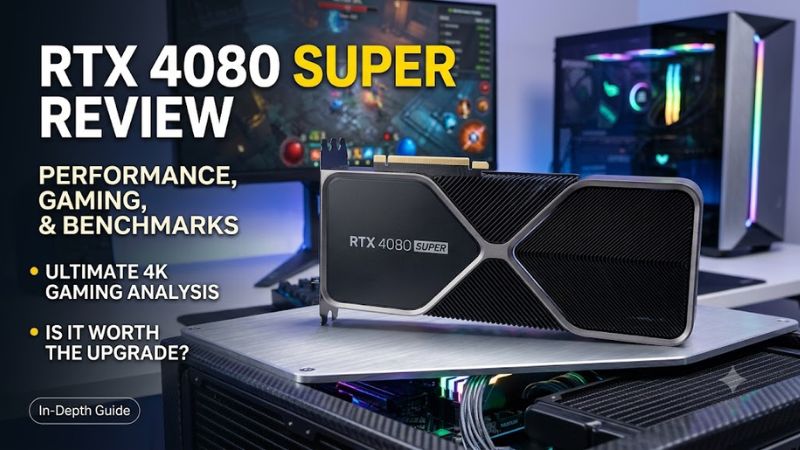
Its most important selling point was not a dramatic architectural change. Instead, NVIDIA increased the number of processing cores, improved memory speed, and introduced the Super model at a more attractive starting price.
The RTX 4080 Super launched with a $999 MSRP, compared with the original RTX 4080’s $1,199 launch price. That $200 reduction made the Super model considerably more attractive at launch.
However, the market has changed since then. Newer GPU generations have entered the market, and remaining RTX 4080 Super inventory can command substantial premiums. Consequently, its original launch value should not be confused with its current purchasing value.
RTX 4080 Super Specifications
The RTX 4080 Super uses NVIDIA’s AD103 GPU and features 10,240 CUDA cores, 80 third-generation RT cores, and 320 fourth-generation Tensor cores.
Its 16GB GDDR6X memory operates across a 256-bit interface, providing 736GB/s of theoretical memory bandwidth.
Here are the primary specifications of the reference graphics card.
| Specification | RTX 4080 Super |
| Architecture | NVIDIA Ada Lovelace |
| GPU | AD103 |
| CUDA cores | 10,240 |
| RT cores | 80 |
| Tensor cores | 320 |
| Base clock | 2,295MHz |
| Boost clock | 2,550MHz |
| Memory capacity | 16GB |
| Memory type | GDDR6X |
| Memory speed | 23Gbps |
| Memory interface | 256-bit |
| Memory bandwidth | 736GB/s |
| Total board power | 320W |
| Interface | PCIe 4.0 x16 |
| Power connector | 16-pin |
| Launch MSRP | $999 |
These specifications describe NVIDIA’s reference configuration. Factory-overclocked graphics cards from ASUS, MSI, Gigabyte, Zotac, and other manufacturers can have different boost clocks, dimensions, cooling arrangements, and power limits.
The 16GB memory capacity is particularly useful for modern games with high-resolution textures and demanding graphical settings. It also provides additional flexibility for video editing, 3D rendering, and GPU-accelerated applications.
Nevertheless, 16GB should not automatically be interpreted as unlimited future-proofing. Some professional workloads and increasingly demanding games can benefit from additional graphics memory.
Architecture and Important Technologies
Ada Lovelace introduces several technologies that contribute to the RTX 4080 Super’s appeal.
DLSS 3 and Frame Generation: NVIDIA’s Deep Learning Super Sampling technology uses AI-assisted rendering to improve performance. DLSS Super Resolution reconstructs higher-resolution images from lower-resolution rendering, while Frame Generation creates additional frames using compatible RTX 40-series hardware.
Ray tracing: Dedicated RT cores accelerate ray-tracing calculations, allowing supported games to produce more realistic lighting, reflections, and shadows.
NVIDIA Reflex: Supported games can use Reflex to reduce system latency, which is particularly useful in competitive shooters.
AV1 encoding: The GPU includes dual eighth-generation NVIDIA encoders with AV1 support, making it useful for supported streaming and video production workflows.
These features make the RTX 4080 Super more than a conventional rasterization graphics card. Its combination of rendering performance, AI-assisted graphics, and encoding capabilities gives it flexibility across gaming and content creation.
RTX 4080 Super Gaming Performance: 1440p and 4K Results
Gaming performance is the most important reason to consider this GPU.
The RTX 4080 Super is designed primarily for high-end 1440p and 4K gaming. It has enough processing capability for demanding graphics settings, including ray tracing, although performance depends on the game, resolution, CPU, and selected rendering features.
To avoid presenting estimates as original testing, this review uses published results from independent hardware publications, particularly TechSpot and Tom’s Hardware.
1440p Gaming Performance
At 1440p, the RTX 4080 Super offers substantial graphics processing capacity.
It is suitable for gamers who want high refresh rates in demanding single-player games while retaining the option to enable advanced visual effects.
However, its performance advantage over the original RTX 4080 is relatively small.
TechSpot’s February 2024 review reported that the RTX 4080 Super was approximately 3% faster than the original RTX 4080 in its 1440p gaming comparison.
That difference is unlikely to transform the gaming experience for someone who already owns an RTX 4080.
For owners of older graphics cards, however, the upgrade can be considerably more meaningful.
The card also works well with 1440p monitors featuring high refresh rates. Competitive players can benefit from its processing capacity, although CPU limitations may become increasingly important when targeting very high frame rates.
For esports titles, the RTX 4080 Super may offer considerably more graphics capability than necessary, depending on the game and competitive settings.
4K Gaming Performance
4K gaming is where the RTX 4080 Super makes the strongest case for itself.
Rendering at 3840 × 2160 requires substantially more graphics processing than 1440p. The card’s 16GB VRAM, memory bandwidth, and Ada Lovelace architecture help it handle demanding games at higher resolutions.
TechSpot’s independent testing found that the RTX 4080 Super was approximately 4% faster than the original RTX 4080 at 4K in its test suite.
The same review found that the RTX 4080 Super was approximately 9% slower than AMD’s Radeon RX 7900 XTX in its tested 4K rasterization results.
These figures reflect that publication’s benchmark selection and test conditions, rather than a universal performance ranking across every game.
The practical takeaway is that the RTX 4080 Super remains a strong 4K GPU, but it does not represent a substantial generational improvement over the original RTX 4080.
Gamers who already own a high-end RTX 4080 system have little reason to upgrade solely for the small performance difference.
Ray Tracing and DLSS Performance
Ray tracing is one of NVIDIA’s major competitive advantages.
The RTX 4080 Super performs particularly well in games with demanding ray-tracing workloads. Its dedicated RT cores accelerate supported rendering operations, allowing it to maintain stronger performance than many competing rasterization-focused alternatives in compatible titles.
DLSS adds another layer of flexibility.
Players can select different upscaling quality modes depending on their resolution and performance requirements. Frame Generation can further increase displayed frame rates in supported games.
However, generated frames are not identical to traditionally rendered frames. Frame Generation increases displayed smoothness but does not proportionally improve the responsiveness of the underlying game simulation.
Players who prioritize competitive responsiveness should consider native rendering performance, frame pacing, and Reflex support rather than relying exclusively on generated FPS.
RTX 4080 Super Power Consumption and Cooling
A high-performance GPU requires an appropriate power supply and sufficient cooling.
The RTX 4080 Super has a reference total board power rating of 320W. Actual consumption varies depending on the game, graphics settings, workload, and individual graphics card.
Tom’s Hardware measured average power consumption of approximately 300W in its 4K Ultra gaming test suite.
Its testing also demonstrated that power consumption changes considerably between workloads, with some games placing substantially less demand on the GPU.
This is important because the 320W specification should not be interpreted as constant power consumption in every application.
PSU Requirements
NVIDIA recommends a 750W system power supply for the RTX 4080 Super reference configuration.
However, the appropriate PSU depends on the complete computer.
A system containing a high-power desktop processor, multiple storage devices, additional cooling, and factory-overclocked components may benefit from a higher-capacity power supply.
Before purchasing, consider:
- PSU quality and available continuous power capacity.
- Compatibility with the graphics card’s 16-pin power connector.
- The manufacturer’s recommended power supply requirements.
- Available PCIe power connections.
- Cable routing and connector clearance.
The 16-pin connector deserves particular attention.
Make sure the connector is fully inserted and that the cable is not sharply bent near the plug. If using an adapter, follow the graphics card manufacturer’s installation instructions and use the required independent PCIe power connections.
A compatible ATX 3.0 or newer power supply with a suitable native GPU cable can simplify installation.
Cooling and Operating Temperatures
The RTX 4080 Super generally uses large heatsinks and multi-fan cooling systems.
Its cooling performance depends on the specific manufacturer model, case airflow, ambient temperature, fan curve, and power settings.
There is no single operating temperature that applies to every RTX 4080 Super graphics card.
For this reason, buyers should examine independent testing of their exact model rather than assuming that every version has identical thermal characteristics.
A spacious case with adequate intake and exhaust airflow is recommended.
Some aftermarket cards are particularly large and thick, potentially occupying three or more expansion slots. Check the manufacturer’s dimensions before installation.
RTX 4080 Super Price in 2026: Is It Still Good Value?
Price is arguably the biggest weakness of the RTX 4080 Super in 2026.
Its original $999 MSRP was an important part of its appeal. NVIDIA effectively corrected the original RTX 4080’s high launch pricing by introducing a slightly faster model at a substantially lower price.
However, the RTX 4080 Super is now an older product, and remaining retail inventory is limited.
US price tracking information checked on November 2, 2026, shows considerable variation between available listings and historical asking prices.
One tracking service recorded new RTX 4080 Super listings around 1,795–2,229 in its November 1 snapshots. Another market tracker reported that major US retailers had no recently confirmed in-stock listings.
Meanwhile, an eBay asking-price tracker reported a used-card low-end asking price around $1,215 and a median around $1,589 on October 28, 2026.
These figures are market observations, not verified completed-sale prices or guaranteed available offers. The different tracking samples also explain why there is no single dependable current street price.
Is the RTX 4080 Super Worth $999?
At its original $999 launch price, the RTX 4080 Super offered strong value for an enthusiast graphics card.
At substantially higher prices, the situation changes.
A card originally positioned as a $999 product becomes difficult to recommend when remaining inventory is priced considerably above that amount.
Potential buyers should compare the total cost against newer GPU alternatives available in their region.
The important considerations include:
- Actual gaming performance at the intended resolution.
- Ray-tracing performance.
- Available VRAM.
- DLSS and other supported technologies.
- Power consumption.
- Warranty and return protection.
- New versus used condition.
A used RTX 4080 Super may be attractive if priced appropriately, but a high asking price does not automatically make it a good purchase simply because the original MSRP was $999.
For a used card, check its physical condition, serial number, warranty eligibility, connector condition, fan operation, and performance stability.
RTX 4080 Super vs. RTX 4080 and Radeon RX 7900 XTX
Understanding the competition helps determine whether the RTX 4080 Super is the right choice.
| Feature | RTX 4080 Super | RTX 4080 | RX 7900 XTX |
| VRAM | 16GB | 16GB | 24GB |
| Memory type | GDDR6X | GDDR6X | GDDR6 |
| Memory interface | 256-bit | 256-bit | 384-bit |
| Architecture | Ada Lovelace | Ada Lovelace | RDNA 3 |
| Ray tracing | Excellent | Excellent | Strong, generally weaker |
| AI upscaling | DLSS | DLSS | FSR |
| Frame generation | DLSS Frame Generation | DLSS Frame Generation | FSR-supported technologies |
| Reference board power | 320W | 320W | 355W |
| Launch MSRP | $999 | $1,199 | $999 |
RTX 4080 Super vs. RTX 4080
The RTX 4080 Super is the better version when both cards have comparable prices.
It features more CUDA cores, slightly higher boost clocks, and faster memory.
Nevertheless, the performance difference is modest.
TechSpot measured approximately 2% improvement at 1080p, 3% at 1440p, and 4% at 4K in its respective test suites.
An existing RTX 4080 owner should not spend significant money upgrading to the Super model.
RTX 4080 Super vs. Radeon RX 7900 XTX
The Radeon RX 7900 XTX offers 24GB of VRAM, providing more memory capacity for certain professional workloads and demanding texture-heavy applications.
AMD’s card can also deliver competitive rasterization performance.
However, NVIDIA has advantages in ray tracing performance and its DLSS ecosystem.
For gamers who prioritize ray tracing, supported AI features, and CUDA-dependent applications, the RTX 4080 Super is an attractive option.
For users who prioritize VRAM capacity and conventional rasterization performance, the RX 7900 XTX deserves consideration.
The final decision should depend on actual pricing and workload rather than specifications alone.
Pros and Cons of the RTX 4080 Super
Pros
- Excellent 1440p and 4K gaming capabilities.
- 16GB of GDDR6X memory.
- Strong ray-tracing performance.
- Support for DLSS Super Resolution and Frame Generation.
- NVIDIA Reflex support in compatible games.
- Dual AV1 encoders for streaming and video production.
- Good performance efficiency for its performance class.
- Suitable for demanding creative applications.
Cons
- Only a small performance improvement over the original RTX 4080.
- Original $999 MSRP is no longer representative of remaining retail prices.
- Limited availability can create substantial price premiums.
- Large aftermarket designs may require spacious PC cases.
- 16-pin power connector requires careful installation.
- 16GB VRAM may limit certain demanding professional workloads.
- Newer GPU generations complicate its long-term value proposition.
Who Should Buy the RTX 4080 Super?
The RTX 4080 Super is still relevant, but its ideal audience is relatively specific.
4K gaming enthusiasts: Players who want high-resolution gaming with demanding graphical settings will appreciate its rendering capability and ray-tracing performance.
Ray-tracing enthusiasts: NVIDIA’s RT hardware and DLSS ecosystem make the card attractive for compatible titles that use demanding lighting and reflection effects.
Content creators: Its CUDA support, 16GB VRAM, and AV1 encoding capabilities make it useful for supported creative applications and streaming workflows.
Owners of older graphics cards: Users upgrading from substantially older GPUs may see a meaningful improvement in gaming performance.
However, existing RTX 4080 owners should generally keep their current cards unless there is another compelling reason to upgrade.
Budget-conscious gamers should also compare the RTX 4080 Super against newer graphics cards before making a purchasing decision.
Frequently Asked Questions
Is the RTX 4080 Super good for 4K gaming?
Yes, the RTX 4080 Super is a powerful 4K gaming GPU. Its 16GB GDDR6X memory, strong rendering performance, ray tracing, and DLSS support make it suitable for demanding modern games.
How much VRAM does the RTX 4080 Super have?
The RTX 4080 Super has 16GB of GDDR6X video memory. It uses a 256-bit memory interface and provides 736GB/s of theoretical memory bandwidth.
Is the RTX 4080 Super better than the RTX 4080?
Yes, the RTX 4080 Super is technically faster than the original RTX 4080. However, independent benchmarks show relatively small improvements, generally around 2–4% in TechSpot’s tested gaming workloads.
Is the RTX 4080 Super worth buying in 2026?
The RTX 4080 Super can still be worth buying if its price is competitive with newer alternatives. However, paying substantially above its original $999 MSRP is difficult to justify without a specific performance or compatibility reason.
Final Verdict: Should You Buy the RTX 4080 Super?
The NVIDIA GeForce RTX 4080 Super remains an impressive high-end graphics card in 2026. Its combination of 16GB GDDR6X memory, strong 4K rendering, ray tracing, DLSS, and creative application support makes it capable of handling demanding workloads.
Its biggest weakness is not performance but value.
The relatively small improvement over the original RTX 4080 means existing owners have little reason to upgrade. Meanwhile, limited remaining inventory and elevated asking prices make purchasing decisions more complicated.
For gamers upgrading from older graphics cards, the RTX 4080 Super can still deliver an excellent experience. However, buyers should compare its actual purchase price with newer alternatives before committing.
Our recommendation: Consider the RTX 4080 Super when you can find a competitively priced card with a reliable warranty. Avoid paying a substantial premium simply because it was once a $999 high-end GPU. In today’s market, the best graphics card is not necessarily the fastest one, but the one that delivers the strongest performance for the money.