Key takeaways
- Graphics card: approximately 115–180W
- Processor under a heavy gaming workload: approximately 65–125W
- Motherboard, memory, SSD, fans, and USB devices: approximately 50–80W
- Estimated gaming total: approximately 230–385W
The best budget gaming PCs for affordable 1080p gaming are usually a Ryzen 5 or Core i5 system with a Radeon RX 7600 or GeForce RTX 4060, 16GB of dual-channel memory, a 1TB NVMe SSD, and a reputable 500–650W power supply.
That combination delivers smooth 1080p gaming without paying for hardware that is better suited to 1440p. The important catch is that similarly priced prebuilts can differ substantially in graphics performance, cooling, upgradeability, storage, and power-supply quality.
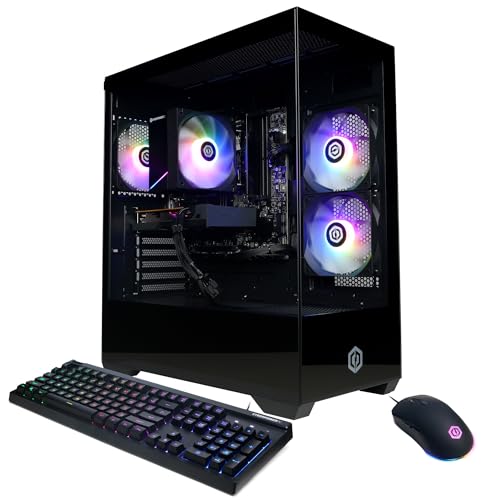
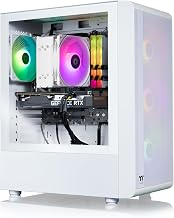
CyberPowerPC Gaming PC, AMD Ryzen 5 5500, Radeon RX 6500 XT 4GB
Included for 'Best Budget Gaming PCs for Affordable 1080p Gaming' because the listing specifies AMD Ryzen 5 5500 and Radeon RX 6500 XT 4GB, details this guide uses to compare options.
View on Amazon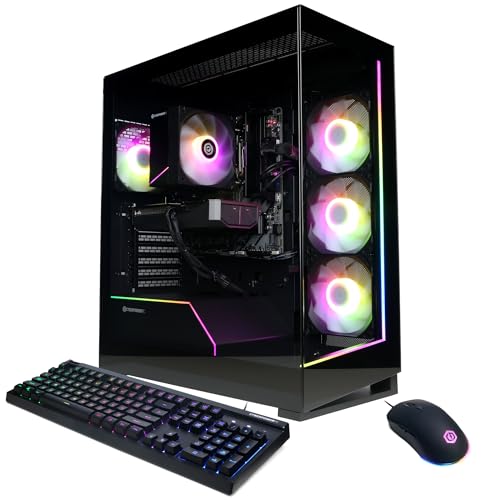
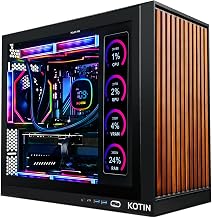
CyberPowerPC Gaming PC, AMD Ryzen 7 8700F, GeForce RTX 5060 Ti 8GB
Included for 'Best Budget Gaming PCs for Affordable 1080p Gaming' because the listing specifies AMD Ryzen 7 8700F and GeForce RTX 5060 Ti 8GB, details this guide uses to compare options.
View on Amazon
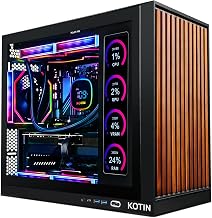
CyberPowerPC Gaming PC, Intel Core i5-14400F, GeForce RTX 5060 8GB
Included for 'Best Budget Gaming PCs for Affordable 1080p Gaming' because the listing specifies Intel Core i5-14400F and GeForce RTX 5060 8GB, details this guide uses to compare options.
View on Amazon
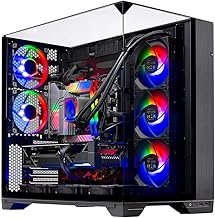
Skytech Gaming PC Desktop, Ryzen 7 9850X3D, RX 9070 XT, 32GB RAM, 2TB SSD
Included for 'Best Budget Gaming PCs for Affordable 1080p Gaming' because the listing specifies Ryzen 7 9850X3D and RX 9070 XT, details this guide uses to compare options.
View on AmazonBest budget gaming PCs at a glance
| PC or configuration class | Typical price range | 1080p target | Best feature | Main compromise |
|---|---|---|---|---|
| HP Victus 15L with Ryzen 5 and RX 7600 | $650–$850 | High settings, often 70–120 fps | Strong graphics performance for the money | Compact case and limited cooling expansion |
| Acer Nitro 50 with Core i5 and RTX 4060 | $750–$950 | High settings, often 80–140 fps | DLSS and ray-tracing support | Proprietary parts may restrict upgrades |
| Lenovo LOQ Tower with Core i5 or Ryzen 5 and RTX 4060 | $800–$1,000 | High settings, often 80–140 fps | Generally sensible internal layout | Configuration availability varies |
| CyberPowerPC Gamer Xtreme with Core i5 and RX 7600 or RTX 4060 | $700–$950 | High settings, often 70–140 fps | Standard components in many configurations | Fan noise and component selection can vary by SKU |
| Integrated-graphics or entry-level discrete-GPU PC | $450–$650 | Medium settings, generally 45–90 fps | Lowest purchase cost | Much less headroom for demanding games |
Frame rates are practical ranges rather than guarantees. The processor, memory configuration, game version, graphics preset, and upscaling mode can all change the result. A particular listing should be judged by its component specification, not just its product name.
Head-to-head: RX 7600 versus RTX 4060
Radeon RX 7600
The RX 7600 is one of the clearest value choices for conventional 1080p gaming. It normally has enough performance for high settings in games such as Forza Horizon 5, Doom Eternal, Resident Evil 4, and Baldur’s Gate 3. Its 8GB of VRAM is appropriate for 1080p, although ultra textures and heavy ray tracing can expose its limits.
Choose an RX 7600 system when the priority is maximum rasterized performance per dollar and you do not expect to use ray tracing frequently. AMD’s FSR upscaling can also improve performance, but game support and image quality vary.
GeForce RTX 4060
The RTX 4060 is often a better all-round choice when the price difference is modest. It offers strong 1080p performance, generally lower power consumption than the RX 7600, and access to DLSS Super Resolution and Frame Generation in supported games. Those features are particularly useful in demanding titles such as Cyberpunk 2077.
Its 8GB VRAM is not an invitation to buy for 4K, but it is serviceable for 1080p with sensible texture settings. Select the RTX 4060 if you value quieter operation, ray tracing, streaming features, or DLSS more than the lowest possible purchase price.
What real 1080p performance should you expect?
| Game type | RX 7600 / RTX 4060 expectation | Recommended settings |
|---|---|---|
| Competitive games such as Valorant or Overwatch 2 | 150–300+ fps, depending on the CPU | Medium or competitive settings |
| Well-optimized action games | 90–160 fps | High settings, native 1080p |
| Recent demanding games | 60–110 fps | High settings with selective reductions |
| Ray-traced games | 45–90 fps before upscaling | Medium ray tracing with DLSS or FSR where available |
For a 60Hz monitor, even 60–80 consistent frames per second is sufficient. A 144Hz monitor benefits from an RTX 4060 or RX 7600, but the processor matters more in competitive games. A six-core Ryzen 5 5600, Ryzen 5 7600, Core i5-12400F, or comparable chip is a sensible minimum for a new gaming desktop.
Check these components before buying
Memory: 16GB is the practical baseline
Buy 16GB as two 8GB modules rather than a single 16GB stick. Dual-channel memory can improve minimum frame rates and prevents the processor from being unnecessarily starved of bandwidth. For example, DDR4-3200 dual-channel memory provides a theoretical 51.2GB/s of bandwidth, while a single module cuts that figure roughly in half.
Choose 32GB if you keep a browser, voice chat, recording software, and mods open while playing. Memory is one of the easiest upgrades, but some compact branded PCs use unusual modules or have only one accessible slot.
Storage: avoid a 512GB-only system if possible
A 1TB NVMe SSD is the better value target. Windows, applications, and several modern games can consume 200GB or more before personal files are added. A 512GB drive may leave less than 350GB usable after the operating system and recovery partition, which can mean uninstalling games almost immediately.
Check whether the motherboard has a second M.2 slot or a free 2.5-inch drive bay. Adding a second SSD is preferable to replacing the boot drive, but proprietary cases can make either process difficult.
Power supply: wattage is not enough
An RTX 4060 system does not need an oversized 750W supply. A quality 500–650W unit is normally sufficient. The more important questions are whether the supply is from a recognizable manufacturer, has appropriate protections, and uses standard connectors.
A useful power-budget calculation is:
- Graphics card: approximately 115–180W
- Processor under a heavy gaming workload: approximately 65–125W
- Motherboard, memory, SSD, fans, and USB devices: approximately 50–80W
- Estimated gaming total: approximately 230–385W
Allowing 30–40% headroom gives a sensible 400–540W requirement, so a reputable 550W supply is comfortable for this class. Avoid a cheap, unnamed 500W unit merely because its printed wattage looks adequate.
Cooling and noise
Small cases can run acceptably with a six-core processor and RTX 4060, but they leave less room for future upgrades. Look for a front mesh panel, at least one front intake fan, and one rear exhaust fan. A tower cooler is generally quieter than a small stock-style cooler during long gaming sessions.
Budget prebuilts are often quiet on the desktop but noticeably louder during a demanding game. If low noise matters, favor the RTX 4060’s lower typical power draw, a mesh-front case, and a system with standard 120mm fan mounts. Avoid assuming that a larger case is automatically quieter; unrestricted airflow and sensible fan curves matter more.
Which budget PC fits your situation?
| Your situation | Best choice | Why |
|---|---|---|
| You want the lowest cost for high-settings 1080p | RX 7600, 16GB, 1TB SSD | Excellent conventional graphics performance without paying for premium features |
| You use ray tracing or want DLSS | RTX 4060, 16GB, 1TB SSD | Better feature support and efficient performance |
| You plan to upgrade the GPU later | Standard mid-tower with a 650W supply | More room, connectors, and thermal capacity |
| You need a compact desktop | Victus 15L or Nitro 50 configuration | Smaller footprint, provided limited expansion is acceptable |
| You mainly play esports titles | Strong six-core CPU with an entry-level GPU | CPU consistency and high frame rates matter more than ultra graphics |
Settings that make a budget PC last longer
Start at high—not ultra—quality, keep textures at high if VRAM usage remains below the card’s limit, and reduce shadows, volumetric effects, and reflections first. These settings often provide a meaningful frame-rate improvement with a small visual penalty.
For a 144Hz display, cap the frame rate a few frames below the monitor’s refresh rate, such as 141fps for 144Hz. This can reduce unnecessary GPU load and smooth variable-refresh behavior. In a demanding game, use quality-mode DLSS or FSR before lowering the entire graphics preset. If frame-time spikes remain, check whether the PC has single-channel memory, excessive background applications, or thermal throttling.
Bottom line
The strongest all-purpose purchase is a prebuilt with a Ryzen 5 or Core i5 processor, RTX 4060 or RX 7600 graphics, 16GB dual-channel memory, a 1TB NVMe SSD, and a named 550W-or-better power supply. The RX 7600 wins when price and standard 1080p performance come first; the RTX 4060 earns its premium through efficiency, DLSS, ray tracing, and broader feature support.
Whichever model you choose, confirm the exact memory layout, power-supply model, available drive slots, and cooling design. Those details determine whether a cheap gaming PC remains a good value after the first year.