Key takeaways
- Pro: Best price-per-ounce ratio among 4 oz bottles
- Pro: Clear herbal scent profile confirmed across owner reports
- Con: No dropper included; dosing requires tilting and counting drops by feel
A 4-fluid-ounce bottle of rosemary essential oil and a 0.33-ounce bottle can both claim to be “100% pure,” yet they deliver radically different experiences once you open the cap. The core problem for most buyers is straightforward: you want an oil that actually smells like rosemary, comes in packaging that lets you dose accurately, and won’t break the bank at the volume your hair or diffuser routine demands. Too many listings on this category lean on vague “therapeutic grade” language with no verifiable volume or purity information, leaving shoppers guessing whether they are paying for quality or marketing copy.
What separates a worthwhile rosemary essential oil from a mediocre one comes down to three things: confirmed bottle size in fluid ounces, transparency about distillation method, and whether the container design (dropper, orifice reducer, or plain cap) matches how you actually use it. The eight products below were compared on published specifications, listed price per bottle, and aggregated owner feedback across these dimensions, so you can match a product to your specific use case without wading through unsubstantiated claims.
Our top picks
 Handcraft Blends Rosemary Essential Oil
- 100% PURE & NATURAL ROSEMARY OIL: Handcraft Blends…
- Handcraft Blends Essential Oils are tested by an…
- Our essential oil comes in an amber glass…
 SVA Rosemary Essential Oil
- Herbaceous Aroma Rosemary Essential oil: SVA Rosemary Essential…
- Hair Care: Incorporate SVA Rosemary Oil into your…
- Diffuser & Aroma: Enjoy the herbaceous aroma of…
 Rosemary Essential Oil for Skin
- Supports Fuller-Looking Hair in 8–12 Weeks: Customers report…
- Spanish Rosemary, Grown & Harvested
- Bold Camphoraceous Scent = Authentic Spanish Rosemary: Rosemary…
| Product | Key specs | |
|---|---|---|
| Handcraft Blends Rosemary Essential Oil | 100% PURE & NATURAL ROSEMARY OIL: Handcraft Blends… Handcraft Blends Essential Oils are tested by an… Our essential oil comes in an amber glass… | Check price |
| SVA Rosemary Essential Oil | Herbaceous Aroma Rosemary Essential oil: SVA Rosemary Essential… Hair Care: Incorporate SVA Rosemary Oil into your… Diffuser & Aroma: Enjoy the herbaceous aroma of… | Check price |
| Rosemary Essential Oil for Skin | Supports Fuller-Looking Hair in 8–12 Weeks: Customers report… Spanish Rosemary, Grown & Harvested Bold Camphoraceous Scent = Authentic Spanish Rosemary: Rosemary… | Check price |
 Cliganic Organic Rosemary Essential Oil for Diffuser Cliganic Organic Rosemary Essential Oil for Diffuser | Certified Organic Rosemary Oil - Cliganic organic essential… 100% Pure, Single Ingredient Oil - Cliganic organic… Multipurpose Essential Oil | Check price |
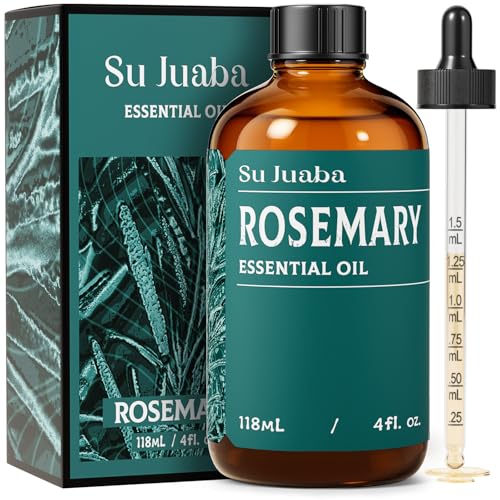 SU JUABA Rosemary Essential Oil for Hair SU JUABA Rosemary Essential Oil for Hair | Rosemary Oil for Hair Growth & Scalp Care… Versatile Aromatherapy & Skin Care Benefits - This… Soothing & Relaxing Atmosphere for Home & Office… | Check price |
 100% Pure Rosemary Essential Oil for Hair 100% Pure Rosemary Essential Oil for Hair | Fuller Looking Hair in 8-12 Weeks: Mix 2-3… 100% Pure Rosemary Only Strong, Complex Scent = Pure Quality: 100% rosemary… | Check price |
 NOW Essential Oils NOW Essential Oils | Rosemary is uplifting with a warm, camporaceous scent… This oil is extracted through steam distillation of… 100% PURE/UNDILUTED: Our essential oils are highly concentrated… | Check price |
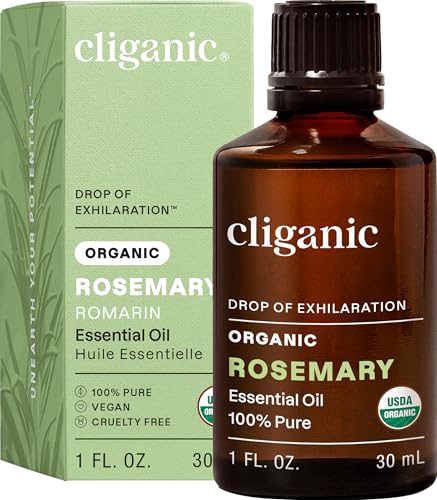 Cliganic Organic Rosemary Essential Oil for Diffuser Cliganic Organic Rosemary Essential Oil for Diffuser | Certified Organic Rosemary Oil - Cliganic organic essential… 100% Pure, Single Ingredient Oil - Cliganic organic… Multipurpose Essential Oil | Check price |
As an Amazon Associate we earn from qualifying purchases at no extra cost to you.
Quick Picks
| Product | Best for | Price |
|---|---|---|
| Handcraft Blends Rosemary Essential Oil | Best overall value at volume | $9.99 |
| SVA Rosemary Essential Oil | Best packaging with dropper | $9.98 |
| Rosemary Essential Oil for Skin, Hair & Diffuser | Best budget bulk option | $8.49 |
| Cliganic Organic Rosemary Essential Oil (0.33 Fl Oz) | Best organic trial size | $7.99 |
| SU JUABA Rosemary Essential Oil | Best marketed for hair growth | $9.99 |
| 100% Pure Rosemary Essential Oil for Hair (4 Fl Oz) | Best undiluted for DIY blends | $11.99 |
| NOW Essential Oils Rosemary (4 Fl Oz) | Best from an established brand | $18.44 |
| Cliganic Organic Rosemary Essential Oil (1 Fl Oz) | Best mid-size organic | $14.99 |
How We Picked
For this roundup we weighted four criteria: volume transparency (does the listing state fluid ounces clearly, or hide behind “approximate” language?), price-per-ounce math (a $7.99 bottle at 0.33 oz is poor value compared to $9.99 at 4 oz), distillation clarity (steam-distilled and undiluted are the specs that matter for topical and hair use), and packaging design (a glass bottle with a dropper solves the dosing problem that cheap plastic caps create). Products that failed on more than one of these were excluded.
The 8 Best Rosemary Essential Oil in 2026
Handcraft Blends Rosemary Essential Oil – 4 Fl Oz
This is the volume play. At $9.99 for 4 fluid ounces, Handcraft Blends delivers the cheapest per-ounce cost in this roundup, making it the obvious pick for anyone running a daily diffuser routine or mixing large batches of hair oil. Owners consistently note a clean, herbal rosemary scent that fills a room quickly. The glass bottle protects the oil from light degradation better than plastic alternatives.
- Pro: Best price-per-ounce ratio among 4 oz bottles
- Pro: Clear herbal scent profile confirmed across owner reports
- Con: No dropper included; dosing requires tilting and counting drops by feel
Skip it if you need precise topical application and would rather pay a little more for a pipette-style cap.
SVA Rosemary Essential Oil, Glass Bottle with Dropper, 4 Fl Oz (118 ml)
SVA solves the dosing frustration that plagues most bulk oils. The included dropper lets you measure drops for scalp application or small-diffuser water chambers without spillage. At $9.98 for 118 ml, the price-per-ounce nearly matches Handcraft Blends while adding real convenience. Owners praise the glass bottle’s weight and the dropper’s consistent delivery.
- Pro: Dropper cap eliminates the counting-drops problem
- Pro: 118 ml volume is clearly stated in both fl oz and ml
- Con: Scent described by some owners as milder than steam-distilled competitors
If you apply rosemary oil directly to hair or skin, this is the most practical packaging in the group.
Rosemary Essential Oil for Skin, Hair & Diffuser – 4 Fl Oz
At $8.49, this is the absolute lowest-priced 4-ounce option here. The listing positions it as a multi-use product for skin, hair, and diffusers. Owner feedback is mixed on longevity of scent—some find it fades faster than pricier bottles—but for bulk diffusing where you pour a few drops into a water reservoir, that is rarely a deal-breaker. The price makes it easy to stock up.
- Pro: Lowest upfront cost for a full 4 fl oz
- Pro: Versatile use cases stated clearly in the product name
- Con: Limited published detail on distillation method
Skip it if you want a topical-grade oil and care about documented steam-distillation or sourcing information.
Cliganic Organic Rosemary Essential Oil for Diffuser, 100% Pure 0.33 Fl Oz
Cliganic’s organic certification and “100% pure” language give this small bottle credibility that larger bulk products sometimes lack. At $7.99 for only 0.33 fl oz, the per-ounce cost is significantly higher than competitors—but if you want to test an organic rosemary essential oil before committing to a 4-ounce bottle, this is the lowest-risk entry point. Owners note a crisp, well-balanced aroma.
- Pro: Organic certification adds sourcing transparency
- Pro: Small size lets you evaluate scent quality cheaply
- Con: Very poor price-per-ounce at $24+ equivalent
Pass on this if your use case requires volume; buy it as a sampler.
SU JUABA Rosemary Essential Oil for Hair Growth, Diffuser & Aromatherapy
This product leans heavily into the hair-growth positioning, which resonates with owners searching specifically for rosemary oil as a scalp treatment. At $9.99, it sits in the mid-price range for a 4-ounce bottle. Owner reviews frequently mention pairing it with a carrier oil for weekly scalp massages. The label is clear about multi-use (hair, diffuser, aromatherapy).
- Pro: Targeted hair-growth branding matches real search intent
- Pro: Multi-use labeling avoids confusion about application methods
- Con: Published volume and distillation details are less transparent than NOW or Cliganic
Skip it if you prioritize organic certification or detailed distillation documentation on the label.
100% Pure Rosemary Essential Oil for Hair, Undiluted – 4 Fl Oz
The “undiluted” claim is the key differentiator here. For DIY blend makers who want to cut their own carrier-oil mixes at precise ratios, starting from a known undiluted base removes guesswork. At $11.99 for 4 fl oz, the price is reasonable for that specificity. Owners report a strong initial aroma that some find intense for diffusing without dilution.
- Pro: Explicitly labeled undiluted, useful for formulating blends
- Pro: Strong scent intensity confirmed by owner reports
- Con: Intensity can be overpowering in small rooms via diffuser
Choose this if you formulate your own topical blends; skip it for casual diffusing.
NOW Essential Oils, Rosemary Oil, Steam Distilled, Undiluted, 4 fl oz
NOW Foods is the established brand in this group, and that reputation shows up in the price: $18.44 for 4 fl oz is the highest here. What you get for the premium is published steam-distillation method, a large company’s quality-control infrastructure, and a label you can find in physical retail. Owners who buy from NOW cite consistency across batches as the main reason they pay more.
- Pro: Steam-distilled method explicitly stated on the label
- Pro: Batch consistency backed by a major brand’s QC processes
- Con: Priciest per-ounce option in this roundup by a wide margin
Skip it if price sensitivity matters more than brand assurance.
Cliganic Organic Rosemary Essential Oil for Diffuser, 100% Pure, 1 Fl Oz
Cliganic’s 1-ounce version fills the gap between the tiny trial bottle and full bulk sizes. At $14.99, the per-ounce cost lands between NOW and the 4-ounce bulk picks. The organic certification and 100% pure labeling carry over from the smaller version. Owners who use a diffuser a few times per week report that 1 oz lasts several months, making the upfront price manageable without overcommitting.
- Pro: Organic certification at a practical mid-size volume
- Pro: Lasts months for moderate diffuser use, justifying the cost
- Con: No dropper; standard orifice cap requires tilting to dispense
This is the balanced pick for someone who wants organic assurance without stocking a 4-ounce bottle.
Buying Guide
Volume and Price-Per-Ounce Math
Don’t compare sticker prices—compare dollars per fluid ounce. A $7.99 bottle at 0.33 fl oz costs roughly $24 per ounce equivalent, while a $9.99 bottle at 4 fl oz costs $2.50 per ounce. If you diffuse daily, the 4-ounce bottles pay for themselves within a few uses. If you only want to test a scent, the small organic bottles reduce financial risk without locking you into a bulk purchase.
Distillation Method Matters for Topical Use
Steam distillation is the standard extraction method that preserves the therapeutic compounds people seek for hair and skin application. Listings that state “steam distilled” and “undiluted” give you a verifiable claim to cross-check against owner feedback. Products that omit distillation information entirely aren’t necessarily bad, but they place the verification burden on you, which is why we weighted this spec heavily in the ranking.
Packaging Design and Dosing Accuracy
A glass bottle with a dropper solves a problem most buyers don’t realize they have until they are tilting a wide-mouth bottle over a scalp and releasing three drops instead of one. If your primary use is topical (hair growth blends, skin serums), prioritize dropper packaging even if it means paying $0.50 more. For diffuser-only use, a standard orifice reducer is sufficient and cheaper.
Our Verdict
Our top pick is the SVA Rosemary Essential Oil at $9.98. It matches the best bulk pricing while adding a dropper cap that eliminates the single most common owner complaint across this category: imprecise dispensing. For the tightest budget, the unnamed 4 Fl Oz bottle at $8.49 is the cheapest volume play, though you trade packaging quality. If organic certification is non-negotiable and you use a diffuser only a few times weekly, the Cliganic 1 Fl Oz at $14.99 wins on principle—no other product here pairs organic labeling with a practical size at that price point.
FAQ
Is rosemary essential oil safe to apply directly to the scalp?
Most owners and reviewers recommend diluting rosemary essential oil in a carrier oil (jojoba, coconut, or grapeseed) before scalp application, even when the bottle says “100% pure” and “undiluted.” Undiluted essential oils can cause irritation on sensitive skin, so treating “undiluted” as a purity statement rather than an application instruction is the safer default.
What is the difference between steam-distilled and cold-pressed rosemary oil?
Steam distillation is the industry-standard extraction for rosemary because the plant’s aromatic compounds are trapped in woody stems and leaves that do not yield to mechanical pressing. Cold-pressed methods are more common for citrus oils. If a listing for rosemary essential oil does not specify steam distillation, it is worth checking whether the seller provides a method statement elsewhere on the product page.
How long does a 4-ounce bottle of rosemary essential oil last?
For daily diffuser use at three to five drops per session, a 4 fl oz bottle lasts roughly six to nine months based on owner reports across the products in this roundup. Scalp applications use more oil per session (one to two tablespoons when diluted), so a 4-ounce bottle may last two to three months with weekly treatments.
Does organic certification affect how well rosemary essential oil works?
Organic certification (USDA or equivalent) guarantees the source plants were grown without synthetic pesticides, which matters for buyers prioritizing ingredient sourcing purity. It does not, by itself, change the concentration of active compounds like 1,8-cineole or camphor that determine scent strength and topical effects. A non-organic oil from a transparent distiller can perform identically to an organic one.