Key takeaways
- Core count: The 9950X3D offers 16 cores and 32 threads across two CCDs; the 9800X3D is a single-CCD 8-core, 16-thread part.
- Cache layout: The 9800X3D puts 96MB of L3 on its only die, so every core touches the big cache. The 9950X3D has 128MB total, but only one CCD carries the stacked cache — the second is a standard high-clock die.
- Clock speeds: The 9950X3D boosts higher (into the 5.7GHz range on its non-cache cores), which helps lightly threaded productivity work; the 9800X3D tops out lower but sustains clocks well.
- Power and cooling: 170W TDP versus 120W. The 9950X3D wants a strong 360mm AIO or a top-tier air cooler under full multi-core load; the 9800X3D is far easier to tame.
- Scheduling complexity: Dual-CCD X3D chips depend on the AMD chipset driver and Windows Game Bar to park the non-cache cores during gaming. The 9800X3D has nothing to schedule and simply works.
- Productivity gap: In Blender, Handbrake, code compiles and other embarrassingly parallel tasks, the 16-core chip is roughly twice as fast. In games, the gap is usually low single-digit percent.
What's inside
The AM5 platform has matured into a remarkably stable place to build a gaming PC, and by 2026 the decision for most enthusiasts has narrowed to two chips wearing the same 3D V-Cache badge: the 16-core Ryzen 9 9950X3D and the 8-core Ryzen 7 9800X3D. Both use Zen 5 cores, both drop into the same Socket AM5 motherboards, and both deliver the enormous stacked L3 cache that makes AMD’s X3D parts so dominant in frame-rate charts.
The difference is what happens outside of games. One is a specialist that does one job better than almost anything else on the market; the other is a genuine do-everything flagship that happens to game at nearly the same level. With GPUs like the RTX 5080 and Radeon RX 9000 series now capable of pushing extremely high frame rates at 1440p, picking the right CPU matters more than it did two generations ago — and so does not overpaying for cores you will never load.
As an Amazon Associate we earn from qualifying purchases at no extra cost to you.


⚡ Save on Your Next PC — Amazon Prime
Prime members get fast free shipping on the systems above, plus early access to Prime Day & Black Friday PC deals. New members get a 30-day free trial.
Watch: Ryzen 9 9950X3D vs 9800X3D: 2026 Showdown — Video Review
Quick Verdict
If you only play games, or you play games and stream casually, the Ryzen 7 9800X3D remains the smartest buy on AM5 — it delivers the vast majority of the 9950X3D’s gaming performance for meaningfully less money and less heat. Choose the Ryzen 9 9950X3D if your machine also earns its keep: video encoding, 3D rendering, compilation, simulation, or heavy multitasking alongside a game. It is the better all-rounder, not the better gaming chip.
Key Differences
- Core count: The 9950X3D offers 16 cores and 32 threads across two CCDs; the 9800X3D is a single-CCD 8-core, 16-thread part.
- Cache layout: The 9800X3D puts 96MB of L3 on its only die, so every core touches the big cache. The 9950X3D has 128MB total, but only one CCD carries the stacked cache — the second is a standard high-clock die.
- Clock speeds: The 9950X3D boosts higher (into the 5.7GHz range on its non-cache cores), which helps lightly threaded productivity work; the 9800X3D tops out lower but sustains clocks well.
- Power and cooling: 170W TDP versus 120W. The 9950X3D wants a strong 360mm AIO or a top-tier air cooler under full multi-core load; the 9800X3D is far easier to tame.
- Scheduling complexity: Dual-CCD X3D chips depend on the AMD chipset driver and Windows Game Bar to park the non-cache cores during gaming. The 9800X3D has nothing to schedule and simply works.
- Productivity gap: In Blender, Handbrake, code compiles and other embarrassingly parallel tasks, the 16-core chip is roughly twice as fast. In games, the gap is usually low single-digit percent.
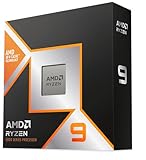
AMD Ryzen 9 9950X3D
The 9950X3D is AMD’s answer to the person who refuses to compromise. You get the cache-loaded CCD for gaming and eight additional high-frequency cores for everything else, which makes it excellent for creators who game, developers running containers in the background, and anyone streaming with a CPU-side encoder. It also holds up better in unusually thread-hungry titles and heavy simulation games — large-scale strategy, city builders and flight sim add-ons — where extra cores occasionally matter.
The trade-off is cost and complexity. You should keep your chipset drivers current so core parking behaves, and you should budget for real cooling. If you would rather skip the parts-picking entirely, prebuilt and bundle options make this chip easy to deploy: the Panorama XL RTX 5080 desktop pairs it with 32GB of DDR5 and a 2TB Gen4 NVMe drive, while Micro Center’s CPU-and-motherboard combos with the GIGABYTE X870E AORUS Elite WIFI7 ICE or the MSI PRO X870E-P cover PCIe 5.0, Gen5 M.2 and Wi-Fi 7 in one purchase.
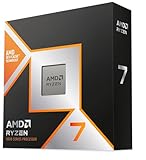
AMD Ryzen 7 9800X3D
Two years after launch, the 9800X3D is still the default recommendation for gaming builds, and that is not nostalgia. Its unified 96MB cache pool means there is no wrong core for a game thread to land on, no driver dependency, and no scheduling edge cases. At 1080p and 1440p with a fast GPU, it trades blows with the 9950X3D and occasionally wins outright, particularly in cache-sensitive engines.
It is also the cheaper, cooler and simpler chip, which frees budget for the component that actually determines your frame rate at 4K: the graphics card. Its weakness is obvious — eight cores is merely adequate for serious rendering or long encodes, and if that is part of your weekly routine, you will notice. For pure play, though, it is hard to argue with.
Which Should You Buy?
- For competitive 1080p/1440p gaming: pick the 9800X3D and spend the savings on your GPU or a higher-refresh monitor.
- For 4K gaming: either works, since the GPU is the bottleneck — buy on price.
- For creator-plus-gamer workloads: pick the 9950X3D; the second CCD pays for itself in export and render times.
- For pure productivity with no gaming: skip both and consider the Ryzen 9 9950X, which offers the same 16 cores without paying for cache you won’t use.
- For maximum cache across every core: watch the newer Ryzen 9 9950X3D2 Dual Edition, which extends stacked cache to both dies for niche cache-bound workloads.
Frequently Asked Questions
Is the 9950X3D actually faster in games?
Marginally, and not consistently. Across a broad suite it lands within a few percent of the 9800X3D, winning some thread-heavy titles and losing a handful of cache-sensitive ones.
Do I need a new motherboard?
No, if you already own an AM5 board — both chips are supported on B650, X670E, B850 and X870E with a current BIOS. New builders should look at X870E for PCIe 5.0 storage, USB4 and Wi-Fi 7.
What cooler do I need?
The 9800X3D is comfortable on a good dual-tower air cooler. For the 9950X3D under sustained all-core load, a 280mm or 360mm liquid cooler is the safer choice.
Is DDR5 speed still important?
Less so than on non-X3D chips, because the cache absorbs many memory requests. A quality DDR5-6000 CL30 kit running EXPO remains the sensible sweet spot for both.
Final Verdict
Buy the Ryzen 7 9800X3D if gaming is the point of the machine — it is the better value and the simpler build. Buy the Ryzen 9 9950X3D if your PC also has a job to do, because it gives up almost nothing in games while doubling your productive throughput. Neither choice is a mistake; only overbuying is.