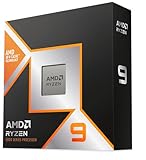
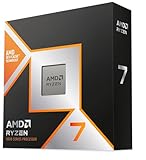
Key takeaways
- L3 cache: The 9800X3D carries 96MB of L3 via second-generation 3D V-Cache (104MB total cache) against just 32MB on the 9700X — the single biggest factor in their gaming gap.
- Gaming performance: Expect roughly 15–25% higher average frame rates at 1080p, with outliers above 40% in cache-sensitive titles like Microsoft Flight Simulator, Factorio, Stellaris, and large-scale strategy or simulation games.
- Clock speeds: The 9700X boosts higher on paper (5.5GHz vs 5.2GHz), but the 9800X3D’s cache more than compensates in real workloads.
- Power and thermals: 120W TDP on the 9800X3D versus 65W stock on the 9700X (with a 105W mode available). The 9700X runs cooler and is far easier to cool with a modest tower air cooler.
- Overclocking: The 9800X3D was the first X3D chip with a fully unlocked multiplier thanks to AMD moving the cache beneath the compute die — it takes both manual OC and PBO. The 9700X is unlocked too but has less headroom to find.
- Price: The 9800X3D commands a significant premium and has spent much of its life supply-constrained. The 9700X is consistently the cheaper entry point to Zen 5.
What's inside
Since its launch, the Ryzen 7 9800X3D has been the default answer to “what’s the best gaming CPU?” — and heading into 2026 it still sits at or near the top of nearly every 1080p and 1440p benchmark chart. Its sibling, the Ryzen 7 9700X, is built on the same Zen 5 architecture, has the same 8-core/16-thread layout, and drops into the same AM5 socket. On paper they look almost identical. In games, they are not.
The gap comes down to one thing: 3D V-Cache. That single design choice separates two chips that otherwise share a die, a platform, and a generation — and it also separates them by a substantial price margin. With AM5 now a mature platform, DDR5 kits cheap, and GPUs like the RTX 5080 and RX 9070 XT capable of pushing frame rates high enough to expose CPU bottlenecks, picking the wrong one of these two can quietly cost you 20% of your performance. Here’s how they actually compare.
As an Amazon Associate we earn from qualifying purchases at no extra cost to you.


⚡ Save on Your Next PC — Amazon Prime
Prime members get fast free shipping on the systems above, plus early access to Prime Day & Black Friday PC deals. New members get a 30-day free trial.
Watch: Ryzen 7 9800X3D vs 9700X: 2026 Gaming CPU — Video Review
Quick Verdict
Buy the AMD Ryzen 7 9800X3D if gaming is your primary workload and you’re pairing it with a mid-to-high-end GPU — it’s the fastest mainstream gaming processor you can install in a desktop, and nothing at this core count comes close. Buy the Ryzen 7 9700X if you want Zen 5 performance on a tighter budget, run a mixed workload of gaming plus productivity, or play at 4K where the GPU does most of the heavy lifting and the cache advantage largely evaporates.
Key Differences
- L3 cache: The 9800X3D carries 96MB of L3 via second-generation 3D V-Cache (104MB total cache) against just 32MB on the 9700X — the single biggest factor in their gaming gap.
- Gaming performance: Expect roughly 15–25% higher average frame rates at 1080p, with outliers above 40% in cache-sensitive titles like Microsoft Flight Simulator, Factorio, Stellaris, and large-scale strategy or simulation games.
- Clock speeds: The 9700X boosts higher on paper (5.5GHz vs 5.2GHz), but the 9800X3D’s cache more than compensates in real workloads.
- Power and thermals: 120W TDP on the 9800X3D versus 65W stock on the 9700X (with a 105W mode available). The 9700X runs cooler and is far easier to cool with a modest tower air cooler.
- Overclocking: The 9800X3D was the first X3D chip with a fully unlocked multiplier thanks to AMD moving the cache beneath the compute die — it takes both manual OC and PBO. The 9700X is unlocked too but has less headroom to find.
- Price: The 9800X3D commands a significant premium and has spent much of its life supply-constrained. The 9700X is consistently the cheaper entry point to Zen 5.
AMD Ryzen 7 9800X3D
The 9800X3D fixed the two complaints people had about the 7800X3D: it clocks higher and it’s no longer a compromise outside of games. Moving the V-Cache layer underneath the CCD improved thermal transfer, which let AMD raise clocks and unlock the chip entirely. The result is a CPU that wins gaming benchmarks outright while roughly matching the 9700X in multi-threaded productivity — Blender, Handbrake, code compilation, and 7-Zip land within a few percent either way rather than the clear loss earlier X3D parts took.
It’s available as a standalone chip, or bundled to save a step: the 9800X3D + TUF Gaming X870-PLUS WiFi kit is a solid mainstream pairing with USB4 and PCIe 5.0, while Micro Center’s combos pair the same CPU with either a GIGABYTE X870 Gaming WiFi 6 board (3× M.2, EZ-Latch) or a more value-focused MSI B850 Gaming Plus WiFi with Wi-Fi 7 and 5G LAN. If you want the newest silicon, the Ryzen 7 9850X3D is the higher-clocked refresh of this same formula — worth a look, though the 9800X3D remains the better value per frame.
AMD Ryzen 7 9700X
Judged on its own terms, the 9700X is an excellent processor. Zen 5’s IPC gains give it strong single-threaded performance, its 65W default TDP makes it genuinely efficient, and it will happily run on a compact air cooler in a small-form-factor build. For anyone whose PC splits time between gaming, content creation, and everyday work, it delivers most of what the 9800X3D does for meaningfully less money.
The catch is that it loses the one benchmark most buyers of an 8-core Ryzen actually care about. If you’re chasing high refresh rates at 1080p or 1440p, the 9800X3D’s frame-time consistency and 1% lows are in a different class. The 9700X’s case strengthens at 4K, in GPU-limited scenarios, and in builds where the savings go toward a better graphics card — which is often the smarter overall spend.
Which Should You Buy?
- For competitive 1080p/1440p gaming: pick the 9800X3D. Frame-time consistency alone justifies it.
- For 4K gaming on a fixed budget: pick the 9700X and put the difference into your GPU.
- For sims, strategy, and MMOs: pick the 9800X3D — these are exactly the workloads V-Cache transforms.
- For mixed gaming and productivity: either works; the 9800X3D wins if you can stretch, the 9700X if efficiency and cooling matter.
- For the simplest upgrade path: pick a bundled CPU + motherboard combo and skip compatibility guesswork entirely.
Frequently Asked Questions
Is the 9800X3D worth the premium over the 9700X?
If gaming is your main use case and you play below 4K, yes. The performance delta is large and consistent, not a benchmark curiosity. For general-purpose builds, the value case is much weaker.
Do both CPUs use the same motherboards?
Yes. Both are AM5 and work on B650, X670, B850, and X870-class boards with a current BIOS. AMD has committed to AM5 support through 2027 and beyond, so either is a safe platform investment.
What about the older Ryzen 7 7800X3D?
Still a superb gaming chip and often cheaper. The 9800X3D is roughly 8–12% faster in games and clearly better in productivity, but the 7800X3D remains excellent value if you find it discounted.
How much cooling does the 9800X3D need?
Neither chip includes a cooler. A quality dual-tower air cooler handles the 9800X3D fine; a 240mm or 280mm AIO gives more headroom for PBO. The 9700X is content with a mid-range air cooler.
Final Verdict
The Ryzen 7 9800X3D is the better gaming CPU by a wide, repeatable margin and remains the sensible flagship choice for a high-refresh gaming build in 2026, espec