Key takeaways
- Core layout: The Ultra 9 285K runs 24 cores (8 P-cores + 16 E-cores) but only 24 threads, since Arrow Lake drops Hyper-Threading. Ryzen 9 sticks with 16 full-fat cores and 32 threads.
- Cache: Intel offers 36 MB of Smart Cache; the Ryzen 9 9950X3D carries up to 128 MB of L3. In cache-sensitive games this is the single biggest performance variable.
- Gaming performance: Ryzen’s X3D parts generally lead at 1080p and 1440p, sometimes by double digits in strategy, sim, and MMO titles. At 4K with a GPU-limited setup, the two converge to near parity.
- Productivity: Intel’s 24 cores are strong in encoding, batch export, and multitasking, and the on-die NPU handles local AI features. Ryzen’s SMT keeps it competitive in compilation and rendering.
- Platform longevity: AM5 has a long, publicly committed support window. LGA 1851 is a newer socket with a shorter roadmap, so plan on a board swap for your next CPU.
- Memory and power: Intel officially supports DDR5-6400 and rates the 285K at 125 W base; Ryzen 9 chips sit around 120–170 W and love a 6000 MT/s 1:1 kit.
What's inside
Two chips sit at the top of almost every high-end build list in 2026: Intel’s Core Ultra 9 285K, the 24-core Arrow Lake flagship on the LGA 1851 platform, and AMD’s Ryzen 9 line, led by the 16-core 9950X3D and its stacked 3D V-Cache. Both will happily feed a top-tier GeForce or Radeon card, and both are fast enough that most players will never feel a bottleneck at 1440p or 4K.
The decision matters more than a single benchmark bar suggests. These two designs solve the same problem in opposite ways — Intel throws a hybrid array of P-cores and E-cores at the workload, AMD throws cache and simultaneous multithreading at it. That difference shows up in frame-time consistency, in streaming and rendering, in cooling requirements, and in how long your motherboard stays relevant. Here’s how they actually compare.
As an Amazon Associate we earn from qualifying purchases at no extra cost to you.


⚡ Save on Your Next PC — Amazon Prime
Prime members get fast free shipping on the systems above, plus early access to Prime Day & Black Friday PC deals. New members get a 30-day free trial.
Watch: Intel Core Ultra 9 vs Ryzen 9: 2026 Battle — Video Review
Quick Verdict
If your priority is the highest possible frame rate in CPU-bound esports and simulation titles, a Ryzen 9 with 3D V-Cache is the safer buy — the huge L3 pool is worth more in games than extra cores. If you split your time between gaming and heavily threaded work like video encoding, 3D rendering, or CAD, the Core Ultra 9 285K delivers more raw throughput per dollar, cooler-running silicon than Intel’s previous generation, and excellent quick-sync media acceleration. Both are overkill for 4K gaming alone.
Key Differences
- Core layout: The Ultra 9 285K runs 24 cores (8 P-cores + 16 E-cores) but only 24 threads, since Arrow Lake drops Hyper-Threading. Ryzen 9 sticks with 16 full-fat cores and 32 threads.
- Cache: Intel offers 36 MB of Smart Cache; the Ryzen 9 9950X3D carries up to 128 MB of L3. In cache-sensitive games this is the single biggest performance variable.
- Gaming performance: Ryzen’s X3D parts generally lead at 1080p and 1440p, sometimes by double digits in strategy, sim, and MMO titles. At 4K with a GPU-limited setup, the two converge to near parity.
- Productivity: Intel’s 24 cores are strong in encoding, batch export, and multitasking, and the on-die NPU handles local AI features. Ryzen’s SMT keeps it competitive in compilation and rendering.
- Platform longevity: AM5 has a long, publicly committed support window. LGA 1851 is a newer socket with a shorter roadmap, so plan on a board swap for your next CPU.
- Memory and power: Intel officially supports DDR5-6400 and rates the 285K at 125 W base; Ryzen 9 chips sit around 120–170 W and love a 6000 MT/s 1:1 kit.
Intel Core Ultra 9 285K: Maximum Cores, Modern Platform
The Core Ultra 9 285K is a 24-core, 125 W unlocked part that boosts to 5.7 GHz on its P-cores. Arrow Lake’s headline achievement isn’t peak frame rate — it’s efficiency. Compared to Raptor Lake, the 285K draws substantially less power under sustained multi-threaded load and runs meaningfully cooler, which makes a 360 mm AIO comfortable rather than mandatory. Paired with a Z890 board you get DDR5-6400 support, PCIe 5.0 for both GPU and SSD, Thunderbolt 4, and Wi-Fi 7.
Bundles are the smart way in. The Micro Center combos pairing the 285K with either the TUF Gaming Z890-Plus WiFi or the MAG Z890 Tomahawk WiFi remove most of the guesswork around VRM quality and BIOS maturity, and both boards have the power delivery to run the chip uncapped. If you’d rather not overclock at all, the locked Core Ultra 9 285 keeps all 24 cores and hits 5.6 GHz at a 65 W base power — an excellent choice for a quiet, compact, or thermally constrained build.
AMD Ryzen 9: Cache-First Gaming Performance
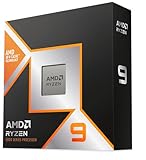
Ryzen 9 takes the opposite approach. Rather than adding efficiency cores, AMD stacks additional L3 cache directly on top of a compute die. Games with large working sets — open-world engines, flight and racing sims, grand strategy, heavily modded titles — hit main memory far less often, which translates into higher minimums and smoother frame pacing. The 9950X3D is the part to beat