Key takeaways
- Pros: Excellent 1440p and strong 4K performance
- 16GB of fast GDDR7 for future-proofing
- DLSS 4 multi-frame generation boosts frame rates
- Wide choice of cooler designs and sizes
What's inside
The GeForce RTX 5070 Ti has emerged as the enthusiast sweet spot of NVIDIA’s Blackwell generation, delivering near-flagship 1440p and 4K performance without the eye-watering price of the RTX 5080. With 16GB of fast GDDR7 memory, PCIe 5.0, and DLSS 4, it is the card most serious gamers should have at the top of their shortlist this year.
Because it is sold by multiple board partners, the 5070 Ti comes in a wide array of designs from ASUS, MSI, GIGABYTE, and PNY, each with different coolers, sizes, and clock speeds. In this review we break down what the 5070 Ti delivers in real games and how to pick the right variant for your build and case.
As an Amazon Associate we earn from qualifying purchases at no extra cost to you.




🎮 Get More From Your Setup — Free
Prime Gaming gives you free PC games every month, in-game loot, and a free Twitch channel sub — plus fast free shipping on all the gear above. New members get a 30-day free trial.
Watch: Gpu 5070 Ti: Review & Buyer’s Guide — Video Review
Design & Build
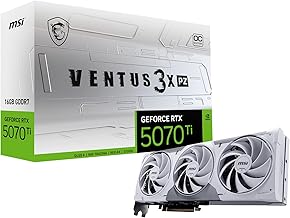
Cooler design is the main differentiator among 5070 Ti cards. Compact SFF-ready models like the ASUS Prime OC and GIGABYTE Eagle OC ICE suit smaller builds, while triple-fan designs such as the MSI Ventus 3X PZ, GIGABYTE Gaming OC, and PNY OC Triple Fan target roomy towers with more thermal headroom and quieter operation. Dual-BIOS switches, axial-tech fans, and reinforced backplates appear across the range. All variants share the same 16GB GDDR7 frame buffer, 256-bit bus, and modern HDMI 2.1b and DisplayPort 2.1a outputs, so display support is uniform.
Performance
This is where the 5070 Ti earns its reputation. At 1440p it delivers well over 100fps in most demanding titles at maxed settings, and it handles 4K gaming confidently, especially with DLSS 4 multi-frame generation enabled. The 16GB of GDDR7 provides ample headroom for high-resolution textures and future games, avoiding the VRAM ceilings that limit lesser cards. Factory-overclocked models like the GIGABYTE Gaming OC and MSI Ventus 3X squeeze out extra frames, though the real-world gap between variants is small, so cooling and noise matter more than a few megahertz.
Pros & Cons
- Pros: Excellent 1440p and strong 4K performance
- 16GB of fast GDDR7 for future-proofing
- DLSS 4 multi-frame generation boosts frame rates
- Wide choice of cooler designs and sizes
- Cons: Priced higher than mainstream RTX 5070
- Triple-fan models require a spacious case
- Frame-generation gains depend on game support
Alternatives to Consider
AMD’s Radeon RX 9070 XT is the closest rival, matching the 5070 Ti on raster performance and VRAM at a competitive price, though it trails in ray tracing and DLSS support. If your budget stretches further, the RTX 5080 offers more 4K headroom, while the standard RTX 5070 saves money for gamers focused on 1440p rather than 4K.
Frequently Asked Questions
Is the RTX 5070 Ti good for 4K gaming?
Yes. It handles 4K confidently in most titles, and DLSS 4 pushes ray-traced games to smooth frame rates even at high settings.
Which 5070 Ti model should I buy?
For most builds a triple-fan design like the MSI Ventus 3X or GIGABYTE Gaming OC balances cooling and noise well; the ASUS Prime OC suits smaller cases.
How much VRAM does it have?
Every 5070 Ti includes 16GB of GDDR7, which is plenty for high-resolution gaming and provides good longevity.
What power supply do I need?
A quality 750W to 850W PSU with the correct PCIe power connectors is recommended for a stable 5070 Ti system.
Verdict
The RTX 5070 Ti is the enthusiast value pick of the Blackwell generation, offering near-5080 performance and a future-proof 16GB frame buffer for less. The MSI Ventus 3X and GIGABYTE Gaming OC are the easiest all-around recommendations, while the ASUS Prime OC wins for compact builds. If you game at 1440p or dip into 4K, this is the card to build around.