Key takeaways
- Core configuration: The RTX 5080 ships with 10,752 CUDA cores against the 5070 Ti’s 8,960 — a 20% shader advantage, plus proportionally more RT and Tensor cores.
- Memory bandwidth: Both carry 16GB of GDDR7 on a 256-bit bus, but the 5080 runs faster memory, giving it close to 960GB/s versus roughly 896GB/s on the 5070 Ti.
- Real-world performance: Expect a 15–20% average frame rate lead for the 5080 at 4K, shrinking to around 10–12% at 1440p where CPU limits start to bite.
- Power draw: The 5080 sits at a 360W board power with a 850W PSU recommendation; the 5070 Ti draws 300W and is comfortable on a quality 750W unit.
- Cooling and size: Premium 5080 coolers are physically enormous — some models occupy nearly four slots — while 5070 Ti designs are generally more compact and case-friendly.
- Value per frame: The 5070 Ti consistently wins on cost per frame; the 5080 wins on absolute ceiling and longevity.
What's inside
Nvidia’s Blackwell lineup has settled into a predictable rhythm, and for most gamers building or upgrading in 2026 the decision narrows to two cards: the GeForce RTX 5080 and the GeForce RTX 5070 Ti. They share the same GB203 silicon, the same 16GB of GDDR7 on a 256-bit bus, and the same DLSS 4 feature set — which makes the gap between them narrower than the naming suggests, but wide enough to matter once you push past 1440p.
The choice matters more now than it did at launch. Engines have leaned hard into path tracing and neural rendering, 4K high-refresh panels have become genuinely affordable, and two years of driver maturity have squeezed extra frames out of both SKUs. Below we break down where the RTX 5080 earns its premium, where the 5070 Ti quietly wins on value, and which board partner designs are worth your attention.
As an Amazon Associate we earn from qualifying purchases at no extra cost to you.




⚡ Save on Your Next PC — Amazon Prime
Prime members get fast free shipping on the systems above, plus early access to Prime Day & Black Friday PC deals. New members get a 30-day free trial.
Watch: RTX 5080 vs 5070 Ti: Worth It in 2026? — Video Review
Quick Verdict
The RTX 5080 is the card to buy if you game at 4K, run a high-refresh ultrawide, or want maximum headroom for path-traced titles and local AI workloads. The RTX 5070 Ti is the smarter buy for 1440p high-refresh gaming and entry-level 4K with DLSS enabled, delivering roughly 80–85% of the performance for a meaningfully smaller outlay and a lighter load on your power supply.
Key Differences
- Core configuration: The RTX 5080 ships with 10,752 CUDA cores against the 5070 Ti’s 8,960 — a 20% shader advantage, plus proportionally more RT and Tensor cores.
- Memory bandwidth: Both carry 16GB of GDDR7 on a 256-bit bus, but the 5080 runs faster memory, giving it close to 960GB/s versus roughly 896GB/s on the 5070 Ti.
- Real-world performance: Expect a 15–20% average frame rate lead for the 5080 at 4K, shrinking to around 10–12% at 1440p where CPU limits start to bite.
- Power draw: The 5080 sits at a 360W board power with a 850W PSU recommendation; the 5070 Ti draws 300W and is comfortable on a quality 750W unit.
- Cooling and size: Premium 5080 coolers are physically enormous — some models occupy nearly four slots — while 5070 Ti designs are generally more compact and case-friendly.
- Value per frame: The 5070 Ti consistently wins on cost per frame; the 5080 wins on absolute ceiling and longevity.
GeForce RTX 5080: Maximum Headroom at 4K
The 5080 is the card that makes 4K feel effortless. With DLSS 4 and Multi Frame Generation enabled, it comfortably clears 120fps in demanding path-traced titles, and its extra shader throughput shows up most clearly in ray-traced workloads where the 5070 Ti starts to strain. It’s also the better choice if you do anything beyond gaming — video encoding, 3D rendering, or running local language models all scale with the additional compute.
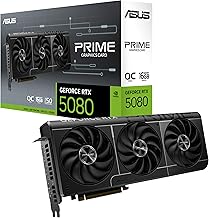
Cooler design varies more here than on any other Blackwell card. The ASUS ROG Astral RTX 5080 is the flagship option with its four-fan, 3.8-slot vapor chamber design and a three-year warranty, though it demands a genuinely large case. The ASUS TUF Gaming RTX 5080 OC is the sensible middle ground, while the GIGABYTE RTX 5080 Gaming OC and PNY Epic-X RGB OC Triple-Fan both offer strong thermals in more conventional footprints. For small form factor builds, the ASUS Prime RTX 5080 OC squeezes into 2.5 slots with dual BIOS, and the GIGABYTE RTX 5080 WINDFORCE OC SFF is purpose-built for compact chassis.
GeForce RTX 5070 Ti: The Value Sweet Spot
The 5070 Ti is arguably the better-balanced product. Cut from the same GB203 die, it retains the full 16GB frame buffer — the single most important spec for longevity — while trimming shader count and clocks. At 1440p it is close enough to the 5080 that most players would struggle to tell them apart in a blind test, and at 4K it remains fully viable with DLSS Quality or Balanced upscaling.
Its practical advantages are underrated. A 300W board power means less heat dumped into your case, quieter fan curves, and compatibility with mainstream 750W power supplies rather than an 850W upgrade. Partner cards are typically shorter and lighter, which matters for mid-tower and SFF builds where a four-fan flagship simply won’t fit. If your monitor tops out at 1440p, the money saved is better spent on a faster CPU or more storage.
Which Should You Buy?
- For 4K 120Hz+ gaming: Pick the RTX 5080 — the extra shaders and bandwidth pay off directly at native and upscaled 4K.
- For 1440p high-refresh: Pick the RTX 5070 Ti; you’ll be CPU-limited in many titles before the GPU becomes the bottleneck.
- For small form factor builds: Either works, but check dimensions carefully — the ASUS Prime or GIGABYTE WINDFORCE SFF 5080 models are the only realistic flagship options.
- For creators and AI workloads: Pick the RTX 5080 for the additional Tensor throughput and faster memory.
- For budget-conscious upgrades: Pick the RTX 5070 Ti and reinvest the difference in a CPU or display upgrade.
Frequently Asked Questions
Is 16GB of VRAM still enough in 2026?
For 4K gaming with upscaling, yes. A handful of titles with ultra texture packs and full path tracing can approach the limit, but neural texture compression in newer engines has eased pressure considerably. Both cards carry the same 16GB, so VRAM is not a differentiator here.
Do I need a new power supply?
Possibly for the 5080. Nvidia recommends 850W for the 5080 and 750W for the 5070 Ti. Both use the 12V-2×6 connector; use the supplied adapter or a native ATX 3.1 cable and ensure it’s fully seated.
How much faster is the 5080 in practice?
Roughly 15–20% at 4K and 10–12% at 1440p, depending on title and whether ray tracing is enabled. The gap widens in heavily ray-traced games and narrows in CPU-bound esports titles.
Are factory-overclocked models worth it?
The clock bump itself is marginal, usually 2–4%. What you’re really paying for is a better cooler and quieter operation, which is worthwhile on the 360W RTX 5080 and less critical on the cooler-running 5070 Ti.
Final Verdict
If you game at 4K or want the longest possible runway before your next upgrade, the RTX 5080 is the clear choice — pick the ASUS TUF or GIGABYTE Gaming OC for balance, the ROG Astral if you have the space, or the ASUS Prime and GIGABYTE WINDFORCE SFF models for compact builds. For everyone else, particularly 1440p players, the RTX 5070 Ti remains the better value and the easier card to live with.