Key takeaways
- Memory: The RX 9070 XT ships with 16GB of GDDR6 on a 256-bit bus; the RTX 5070 has 12GB of faster GDDR7 on a narrower 192-bit bus. The Radeon’s capacity advantage shows up in 4K texture-heavy titles and heavily modded games.
- Rasterization: Across a broad 1440p suite the 9070 XT typically leads the 5070 by roughly 15–25%, which is often the difference between locking 100 fps and settling for 80.
- Ray tracing: RDNA 4 closed most of the historic gap. The 9070 XT now matches or beats the 5070 in many RT workloads, though heavy path-traced titles still favour NVIDIA’s hardware and denoising.
- Upscaling and frame gen: FSR 4 is a genuine leap and looks excellent, but DLSS 4 has broader game support and Multi Frame Generation remains NVIDIA’s headline feature.
- Power and cooling: The RTX 5070 draws roughly 250W, while 9070 XT cards sit near 300W and run higher on factory-overclocked models. Radeon buyers should budget a stronger PSU and more case airflow.
- Productivity: CUDA, OptiX and NVENC still dominate professional rendering, streaming and AI tooling. If your workflow names NVIDIA in its documentation, that settles it.
What's inside
Two years into the RDNA 4 and Blackwell era, the upper-mid-range graphics card fight has settled into a genuinely close contest — and in 2026 it comes down to the Radeon RX 9070 XT and the GeForce RTX 5070. Both target the same buyer: someone building or upgrading a 1440p gaming rig who wants high refresh rates today and enough headroom to stretch into 4K with upscaling. Both use PCIe 5.0, both offer modern display outputs, and both are now widely available at prices well below their launch-day chaos.
The difference matters more than it did at launch. Game install sizes and texture budgets have grown, ray tracing is now a default rather than an option in many AAA titles, and frame generation has become part of how people actually play. That pushes the decision toward two questions: how much raw rasterization performance you get per dollar, and how much you value NVIDIA’s software stack. The RX 9070 XT and RTX 5070 answer those questions very differently.
As an Amazon Associate we earn from qualifying purchases at no extra cost to you.




⚡ Save on Your Next PC — Amazon Prime
Prime members get fast free shipping on the systems above, plus early access to Prime Day & Black Friday PC deals. New members get a 30-day free trial.
Watch: RX 9070 XT vs RTX 5070: 2026 Comparison — Video Review
Quick Verdict
The Radeon RX 9070 XT is the better raw gaming card and the safer long-term buy: it is meaningfully faster at 1440p and 4K, and its 16GB frame buffer removes the biggest question mark hanging over this tier. The RTX 5070 is the better choice if you rely on DLSS 4 and Multi Frame Generation, do content creation or AI work that leans on CUDA and NVENC, or want a lower-power card for a small, quiet build. For pure gaming value, Radeon wins; for ecosystem and efficiency, GeForce still holds the edge.
Key Differences
- Memory: The RX 9070 XT ships with 16GB of GDDR6 on a 256-bit bus; the RTX 5070 has 12GB of faster GDDR7 on a narrower 192-bit bus. The Radeon’s capacity advantage shows up in 4K texture-heavy titles and heavily modded games.
- Rasterization: Across a broad 1440p suite the 9070 XT typically leads the 5070 by roughly 15–25%, which is often the difference between locking 100 fps and settling for 80.
- Ray tracing: RDNA 4 closed most of the historic gap. The 9070 XT now matches or beats the 5070 in many RT workloads, though heavy path-traced titles still favour NVIDIA’s hardware and denoising.
- Upscaling and frame gen: FSR 4 is a genuine leap and looks excellent, but DLSS 4 has broader game support and Multi Frame Generation remains NVIDIA’s headline feature.
- Power and cooling: The RTX 5070 draws roughly 250W, while 9070 XT cards sit near 300W and run higher on factory-overclocked models. Radeon buyers should budget a stronger PSU and more case airflow.
- Productivity: CUDA, OptiX and NVENC still dominate professional rendering, streaming and AI tooling. If your workflow names NVIDIA in its documentation, that settles it.
Radeon RX 9070 XT: The Performance Pick
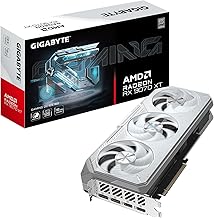
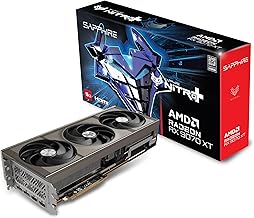
The RX 9070 XT is the card to buy if frames per dollar is your metric. Its 64 RDNA 4 compute units and 16GB of memory make it comfortable at 1440p ultra in essentially everything shipping today, and competent at 4K with FSR 4 Quality enabled. Board partners have also matured: the GIGABYTE RX 9070 XT Gaming OC 16G and its Gaming OC ICE sibling offer high factory clocks with substantial triple-fan coolers, while the ASRock RX 9070 XT Challenger OC pushes a 2970 MHz boost clock with DisplayPort 2.1a and HDMI 2.1b outputs.
Form factor is where the range diverges. The ASUS Prime RX 9070 XT OC keeps things to a 2.5-slot design with dual BIOS and ball-bearing Axial-tech fans, making it the most build-friendly option for mid-tower cases. The PowerColor Reaper is the compact, value-oriented choice, and the XFX Swift splits the difference with a triple-fan cooler and a clean, understated shroud. Whichever you pick, plan for a quality 750W supply and check clearance — several of these cards run close to 2.7 slots.
GeForce RTX 5070: The Ecosystem Pick
The RTX 5070 loses the raw performance argument but wins several practical ones. At around 250W it is easier to cool, easier to power, and easier to fit into compact or airflow-limited builds. Blackwell’s GDDR7 memory helps offset the narrower bus, and NVIDIA’s efficiency advantage translates into quieter cards and lower sustained temperatures under long sessions.
The real draw is software. DLSS 4 remains the most widely supported upscaler, transformer-model image quality is excellent, and Multi Frame Generation can push high-refresh monitors in ways Radeon currently cannot match in supported titles. Add NVENC for streaming, CUDA for Blender and DaVinci Resolve, and broad support in local AI tooling, and the 5070 becomes a compelling all-rounder — provided you can live with 12GB, which is the card’s clearest limitation heading into the next console-driven asset jump.
Which Should You Buy?
- For 1440p high-refresh gaming: Pick the RX 9070 XT — it delivers more frames in the widest range of titles.
- For 4K with upscaling: Pick the RX 9070 XT for its 16GB buffer and stronger raw throughput.
- For streaming or content creation: Pick the RTX 5070 for NVENC, CUDA and broader application support.
- For small form factor or quiet builds: Pick the RTX 5070, or the compact PowerColor Reaper if you prefer Radeon.
- For heavy path-traced titles: Pick the RTX 5070 and lean on DLSS 4 with frame generation.
Frequently Asked Questions
Is 12GB of VRAM still enough in 2026?
For 1440p, generally yes — but it is increasingly tight at 4K with ultra textures and ray tracing enabled. The 9070 XT’s 16GB provides more comfortable headroom for the next few years.
How does FSR 4 compare to DLSS 4?
FSR 4 is close in image quality and a huge improvement over FSR 3, but DLSS 4 still has wider game support and NVIDIA’s Multi Frame Generation has no direct Radeon equivalent.
What power supply do I need?
Plan on a quality 750W unit for the RX 9070 XT and 650W for the RTX 5070, with appropriate connectors and some headroom for transient spikes.
Which RX 9070 XT model should I choose?
Buy on cooler quality and case fit rather than factory clocks — the difference between models is usually a few percent. The ASUS Prime suits tighter builds; the GIGABYTE Gaming OC and XFX Swift favour cooling capacity.
Final Verdict
If you are building a gaming PC and nothing else, the Radeon RX 9070 XT is the stronger buy in 2026 — more performance, more memory, and a mature software stack behind it. Choose the RTX 5070 only if DLSS 4, NVENC or CUDA are genuinely part of how you use your machine, or if power and size constraints make the lower-wattage card the practical answer.