Key takeaways
- IPS: Best color and viewing angles, as seen on the ASUS TUF and Acer Nitro.
- VA: Deeper contrast, common on curved models like the Samsung Odyssey G55C.
- Flat vs curved: Curved 1000R and 1500R panels wrap around your vision for immersion.
- Ultrawide: A 34-inch 3440×1440 screen adds horizontal space for sim and strategy games.
What's inside
- Watch: How To Choose A Gaming Monitor — Video Review
- Match Resolution to Your GPU
- Prioritize Refresh Rate and Response Time
- Understand Panel Types and Curves
- Check Adaptive Sync and Connectivity
- Consider Size, Ergonomics, and Extras
- Related Guides
- Frequently Asked Questions
- Conclusion
- Related Articles
- Related Guides
Choosing a gaming monitor in 2026 means navigating a maze of refresh rates, resolutions, panel types, and curves. The display is where all your PC’s horsepower actually reaches your eyes, so the wrong choice can bottleneck an otherwise great rig. The good news is that a few key specs tell you almost everything you need to know.
- Watch: How To Choose A Gaming Monitor — Video Review
- Match Resolution to Your GPU
- Prioritize Refresh Rate and Response Time
- Understand Panel Types and Curves
- Check Adaptive Sync and Connectivity
- Consider Size, Ergonomics, and Extras
- Related Guides
- Frequently Asked Questions
- Conclusion
- Related Articles
- Related Guides
This guide breaks down those specs in plain terms and points to real examples across sizes and budgets, so you can match a monitor to your GPU, your games, and your desk. By the end you will know exactly what to prioritize.
As an Amazon Associate we earn from qualifying purchases at no extra cost to you.


⚡ Save on Your Next PC — Amazon Prime
Prime members get fast free shipping on the systems above, plus early access to Prime Day & Black Friday PC deals. New members get a 30-day free trial.
Watch: How To Choose A Gaming Monitor — Video Review
Match Resolution to Your GPU
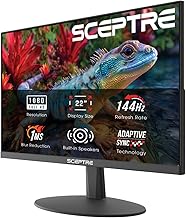
Resolution sets both sharpness and the load on your graphics card. A 1080p panel like the Sceptre 22-inch 144Hz keeps frame rates high on modest hardware, while a 1440p display such as the ASUS TUF VG27AQ3A or Samsung Odyssey G5 suits mid-range and higher GPUs. Ultrawide options like the SANSUI 34-inch UWQHD immerse you further but demand more power.
Prioritize Refresh Rate and Response Time
Refresh rate determines motion smoothness. Competitive players should target 144Hz or more; the Sceptre Curved 240Hz panel is built for fast shooters, while 165Hz to 180Hz options like the Acer Nitro KG271U hit a sweet spot for most. Pair a high refresh rate with a 1ms response time to minimize blur.
Understand Panel Types and Curves
- IPS: Best color and viewing angles, as seen on the ASUS TUF and Acer Nitro.
- VA: Deeper contrast, common on curved models like the Samsung Odyssey G55C.
- Flat vs curved: Curved 1000R and 1500R panels wrap around your vision for immersion.
- Ultrawide: A 34-inch 3440×1440 screen adds horizontal space for sim and strategy games.
Check Adaptive Sync and Connectivity
AMD FreeSync and NVIDIA G-Sync compatibility eliminate tearing by syncing the display to your GPU. Most modern monitors, including the Samsung Odyssey and SANSUI ultrawide, support FreeSync. Confirm you have the right ports too; HDMI 2.1 or DisplayPort 1.4 is needed to drive high refresh rates at higher resolutions.
Consider Size, Ergonomics, and Extras
Screen size should match your viewing distance and desk depth. A 27-inch 1440p panel is the popular all-rounder, while 32-inch and 34-inch curved screens like the Samsung G55C reward larger desks. Look for height-adjustable stands, built-in speakers, and features like a black equalizer or AI crosshair that add competitive convenience.
Frequently Asked Questions
What resolution should I choose?
1080p for budget builds and esports, 1440p for the best balance of clarity and performance, and ultrawide 3440×1440 for immersion if your GPU can handle it.
Is a high refresh rate worth it?
Yes for fast-paced games. Jumping from 60Hz to 144Hz or beyond, like the Sceptre 240Hz, makes motion dramatically smoother and aiming easier.
Curved or flat monitor?
Curved panels boost immersion on larger and ultrawide screens; flat panels are fine for 27 inches and under and for precise competitive play.
Do I need FreeSync or G-Sync?
Adaptive sync noticeably reduces tearing, so choose a monitor that matches your GPU brand. Many panels, including the ASUS TUF, support both ecosystems.
Conclusion
The best gaming monitor is the one balanced to your GPU, your favorite genres, and your desk. Match resolution to your hardware, prioritize a high refresh rate and low response time, pick a panel type and curve that suit your games, and confirm adaptive sync and ports. Get those right and any display in this guide will transform how your games look and feel.