Key takeaways
- Refresh rate over resolution: At this budget, a 144Hz 1080p panel will feel noticeably smoother in competitive games than a 60Hz 1440p one. Only step up to QHD if your GPU can actually drive it and you mostly play slower-paced, visually rich titles.
- Panel type matters more than you think: IPS gives you the best color and viewing angles, VA delivers deeper contrast for dark scenes, and TN is fastest but washes out off-axis. Most sub-$200 monitors use IPS or VA — check before you buy.
- Adaptive sync is non-negotiable: AMD FreeSync (and G-Sync Compatible certification) eliminates screen tearing without the input lag of V-Sync. Nearly every worthwhile budget monitor supports it, so skip any that don’t.
- Check the ports you’ll actually use: DisplayPort is required to hit high refresh rates reliably on PC. If you’re gaming on a PS5 or Xbox Series X, prioritize HDMI 2.0 or better. Dual HDMI is a bonus for multi-device setups.
- Don’t overpay for features you won’t notice: HDR400, built-in speakers, and RGB lighting add cost without meaningfully improving gameplay at this price. Put your money into refresh rate, panel quality, and a solid warranty instead.
What's inside
Shopping for a gaming monitor under $200 in 2026 means navigating a market flooded with panels that all claim high refresh rates, wide color coverage, and “gaming-grade” response times. The reality is that budget monitors involve real trade-offs: a 144Hz panel at this price often means a smaller screen, a larger screen usually means a lower refresh rate, and QHD resolution typically pushes you toward the very top of the budget. Knowing which compromise to accept is the difference between a monitor you love and one you replace in a year.
This guide covers six monitors that genuinely land under $200 and are worth your money in 2026. We’ve focused on the specs that actually affect gameplay — refresh rate, response time, panel type, and adaptive sync support — rather than marketing numbers. Whether you want maximum frames for competitive shooters, a sharper QHD image for single-player titles, or a larger screen for mixed work and play, there’s a pick here that fits.
As an Amazon Associate we earn from qualifying purchases at no extra cost to you.







⚡ Save on Your Next PC — Amazon Prime
Prime members get fast free shipping on the systems above, plus early access to Prime Day & Black Friday PC deals. New members get a 30-day free trial.
Watch: Best Gaming Monitor Under $200 — Video Review
How to Choose Gaming Monitor Under $200
- Refresh rate over resolution: At this budget, a 144Hz 1080p panel will feel noticeably smoother in competitive games than a 60Hz 1440p one. Only step up to QHD if your GPU can actually drive it and you mostly play slower-paced, visually rich titles.
- Panel type matters more than you think: IPS gives you the best color and viewing angles, VA delivers deeper contrast for dark scenes, and TN is fastest but washes out off-axis. Most sub-$200 monitors use IPS or VA — check before you buy.
- Adaptive sync is non-negotiable: AMD FreeSync (and G-Sync Compatible certification) eliminates screen tearing without the input lag of V-Sync. Nearly every worthwhile budget monitor supports it, so skip any that don’t.
- Check the ports you’ll actually use: DisplayPort is required to hit high refresh rates reliably on PC. If you’re gaming on a PS5 or Xbox Series X, prioritize HDMI 2.0 or better. Dual HDMI is a bonus for multi-device setups.
- Don’t overpay for features you won’t notice: HDR400, built-in speakers, and RGB lighting add cost without meaningfully improving gameplay at this price. Put your money into refresh rate, panel quality, and a solid warranty instead.
The Best Picks Reviewed
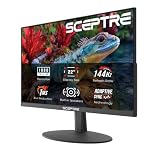
Sceptre 22-Inch 144Hz Gaming Monitor (E225W-FW144)
This is the value play for competitive players who care about frames above all else — a genuine 144Hz refresh rate with both HDMI and DisplayPort at a price that leaves room in the budget for a better mouse. The 22-inch size is compact, but at typical desk distance it keeps the entire playfield in your peripheral vision, which is exactly what you want in fast-paced shooters.
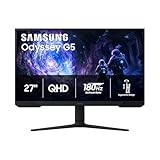
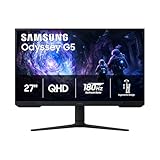
Samsung 27″ Odyssey G5 (G51F) QHD
The Odyssey G5 is the sharpest picture on this list, and 1440p on a 27-inch panel hits the pixel density sweet spot where text stays crisp and games look genuinely detailed. It sits at the top of the sub-$200 range, so it’s the pick for anyone with a mid-range GPU who wants image quality rather than raw frame counts.
ArcticPro 22-Inch 144Hz Gaming Monitor
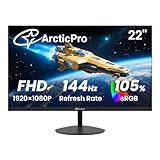
ArcticPro pairs a 144Hz refresh rate with 105% sRGB coverage, which is unusually good color accuracy for a budget 22-inch panel — most competitors at this price cut corners here. It’s a strong choice if you edit photos or watch a lot of content between gaming sessions and don’t want a washed-out image.
Sceptre 27-inch Prime Gaming Monitor (E275W-FW100T)
If screen real estate is your priority, this 27-inch panel delivers 100Hz, 1ms response, 100% sRGB, and FreeSync in a frameless design that looks far more expensive than it is. The refresh rate is a step down from the 144Hz options, but for single-player games, racing sims, and general desktop work the extra size is the better trade.
Philips 221V8LB 22-Inch FHD Monitor
The Philips uses a VA panel, which means noticeably deeper blacks and better contrast than the IPS competition — a real advantage in horror games and dark environments. At 100Hz with flicker-free backlighting and VESA mounting support, it’s the sensible, no-drama option for budget builds and secondary displays.
Frequently Asked Questions
Is 144Hz worth it under $200?
Absolutely, and it’s the single biggest upgrade you can make in this price bracket. The jump from 60Hz to 144Hz is immediately noticeable in aiming, tracking, and general responsiveness — far more so than a resolution bump you’d need a stronger GPU to actually use.
Should I get 1080p or 1440p at this budget?
Stick with 1080p unless you own at least an RTX 4060 or RX 7600 class GPU. Running 1440p on weaker hardware forces you to drop settings so far that the sharpness advantage disappears, and you’ll lose frames you can’t afford in competitive games.
Do these monitors work with PS5 and Xbox Series X?
Yes, all of them will connect and display fine over HDMI. Just note that most sub-$200 panels top out at 1080p/120Hz over HDMI at best, so you won’t get the full 4K/120 output these consoles are capable of.
Is a curved monitor better for gaming?
At 24 inches and below, curvature makes very little practical difference — it becomes genuinely immersive at 27 inches and above, or on ultrawide panels. The Sceptre C248W’s R1500 curve is a pleasant bonus rather than a reason to buy on its own.
Final Thoughts
For most players, the Sceptre 22-Inch 144Hz (E225W-FW144) is the smartest buy under $200 — it delivers the high refresh rate that actually improves your gameplay without stretching the budget. If you have a capable GPU and want the best image quality on this list, the Samsung Odyssey G5 (G51F) in QHD is worth the extra spend, while the Sceptre 27-inch Prime (E275W-FW100T) is the pick for anyone who values a larger screen for both gaming and everyday work.