Key takeaways
- Refresh rate: Aim for 144Hz minimum and 240Hz-plus if you play ranked shooters; the jump from 144Hz to 240Hz is smaller than 60Hz to 144Hz but still visible in flick fights.
- Response time: Look for 1ms MPRT or GtG; a fast refresh means little if the pixels smear behind moving targets.
- Panel type: IPS gives the best color and viewing angles, VA delivers deeper contrast for dark maps, and fast TN survives only on the cheapest speed-focused screens.
- Resolution vs frame rate: FHD 1080p is easiest to drive at 240Hz-plus; QHD 1440p looks sharper but demands a stronger GPU to keep frames high.
- Adaptive sync: FreeSync or G-Sync compatibility removes tearing without adding input lag, so confirm your GPU and monitor agree.
In competitive FPS games, the monitor is the piece of hardware that most directly turns reaction time into wins. A 240Hz or 300Hz panel does not make you aim better on its own, but it does show enemy movement sooner and with less blur, which is exactly the edge you want in a peeker’s-advantage fight. In 2026 the good news is that high-refresh gaming monitors have collapsed in price, and you no longer need to spend $400 to get a genuinely fast display.
This roundup pulls together fast FHD and QHD panels that suit shooters, from a $67 144Hz starter to a curved 240Hz screen and a 32-inch 180Hz QHD option for players who want desktop real estate. We weighted refresh rate, response time, panel type, and value, then matched each pick to a specific kind of FPS player so you are not guessing.
Our top picks
 SANSUI 27 Inch Curved 240Hz Gaming Monitor
- Product Group: Personal Computer
- Binding: Electronics




As an Amazon Associate we earn from qualifying purchases at no extra cost to you. Ratings are shown as listed on Amazon.
⚡ Save on Your Next PC — Amazon Prime
Prime members get fast free shipping on the systems above, plus early access to Prime Day & Black Friday PC deals. New members get a 30-day free trial.
Watch: Best Gaming Monitor for FPS — Video Review
How to Choose
- Refresh rate: Aim for 144Hz minimum and 240Hz-plus if you play ranked shooters; the jump from 144Hz to 240Hz is smaller than 60Hz to 144Hz but still visible in flick fights.
- Response time: Look for 1ms MPRT or GtG; a fast refresh means little if the pixels smear behind moving targets.
- Panel type: IPS gives the best color and viewing angles, VA delivers deeper contrast for dark maps, and fast TN survives only on the cheapest speed-focused screens.
- Resolution vs frame rate: FHD 1080p is easiest to drive at 240Hz-plus; QHD 1440p looks sharper but demands a stronger GPU to keep frames high.
- Adaptive sync: FreeSync or G-Sync compatibility removes tearing without adding input lag, so confirm your GPU and monitor agree.
The Best Picks Reviewed
SANSUI 24.5-Inch 300Hz/240Hz FHD Gaming Monitor
At around $120 this is the pure-speed pick, built specifically for FPS with a 300Hz mode that leaves almost no motion blur. The 24.5-inch FHD size is the competitive standard because the entire play area sits in your central vision. If your only goal is the fastest possible display on a budget, start here.
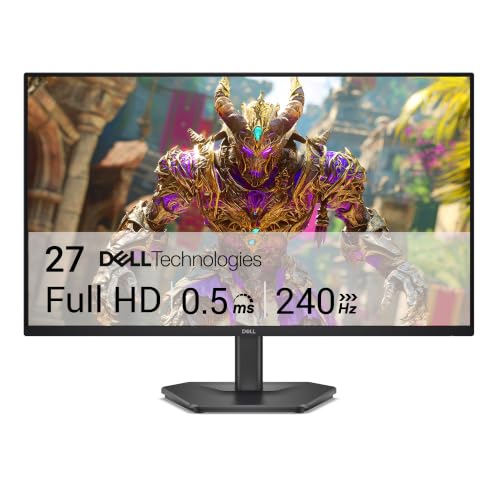
Dell 27 240Hz Gaming Monitor SE2726HG
Near $150, this 27-inch FHD IPS panel pairs 240Hz with in-plane switching for better color and viewing angles than the cheap TN crowd, plus AMD FreeSync Premium and dual HDMI. It is the balanced all-rounder for players who want speed but also use the screen for everything else.
SANSUI 27-Inch Curved 240Hz FHD Monitor
This 1500R curved panel at roughly $140 wraps the action slightly around you and touts 130 percent sRGB coverage with a 4000:1 contrast ratio, so dark corners stay readable. The curve is a personal preference, but for immersive single-monitor setups it is a value standout.
LG 32GS60QC-B UltraGear 32-Inch Curved QHD 180Hz
At about $200 this is the pick for players who want a bigger, sharper QHD canvas without dropping to 60Hz. The 1000R curve, 1ms response, HDR10, and a built-in Black Stabilizer and FPS crosshair overlay make it a comfortable competitive-plus-everything display, provided your GPU can push 1440p frames.
Sceptre E225W-FW144 22-Inch 144Hz FHD
The $67 entry point proves you no longer need a big budget to leave 60Hz behind. This compact 22-inch 144Hz panel with built-in speakers is the ideal first fast monitor, a dorm or secondary display, or a gift for a new PC gamer who is still on a 60Hz office screen.
Frequently Asked Questions
Is 240Hz worth it over 144Hz for FPS?
For ranked and tournament play, yes; the extra frames reduce blur and show movement a touch sooner. For casual play, 144Hz already feels dramatically smoother than 60Hz, and you may prefer to spend the difference on resolution.
Should I pick FHD or QHD for competitive shooters?
FHD 1080p is the competitive default because it is easy to run at very high frame rates and keeps the image in central vision. Choose QHD only if your GPU is strong enough to hold high frames and you value sharpness for mixed use.
Do I need G-Sync or is FreeSync fine?
FreeSync is fine and is now broadly compatible with both AMD and Nvidia GPUs. It eliminates tearing with no meaningful input-lag penalty, so there is rarely a reason to pay a G-Sync premium for FPS play.
What refresh rate can my GPU actually hit?
In popular esports titles at 1080p, mid-range 2026 GPUs routinely exceed 240fps, so a 240Hz panel is not wasted. In AAA games you may fall short, but FPS competitors mostly play lighter titles that run very fast.
Final Thoughts
The best FPS monitor is the fastest one your GPU can feed at a size that keeps the action in your central vision. For pure competitive speed on a budget, the 300Hz SANSUI is hard to beat; for a balanced daily display, the Dell 240Hz IPS is the safe pick; and if you want a bigger sharper canvas, the LG 32-inch QHD delivers. Match the panel to your GPU and your game library, and any screen here will feel like an upgrade.