Key takeaways
- Mice: lightweight models such as the Logitech G305 Lightspeed can run weeks on a single AA, while rechargeable flagships last days between top-ups.
- Headsets: expect 20 to 40 hours; get in the habit of charging overnight so you are never caught mid-session.
- High polling rates: running 4000Hz or 8000Hz wireless drains batteries dramatically faster than the standard 1000Hz.
What's inside
- Watch: Wired vs Wireless Gaming Gear: Which Is Better? — Video Review
- How Much Does Latency Really Matter?
- Battery Life and Charging Habits
- Connection Stability and Interference
- Weight, Comfort, and Cable Drag
- Total Cost and Long-Term Value
- Tips
- Related Guides
- Frequently Asked Questions
- Conclusion
- Related Articles
- Related Guides
The wired-versus-wireless debate used to have a simple answer: if you cared about winning, you plugged in. In 2026 that answer is far less clear. Modern wireless protocols like Logitech’s Lightspeed and Razer’s HyperSpeed now push latency so low that most players genuinely cannot feel the difference, while cable clutter, tug, and drag remain very real annoyances on a busy desk. Choosing between the two is now about matching the technology to how you actually play.
- Watch: Wired vs Wireless Gaming Gear: Which Is Better? — Video Review
- How Much Does Latency Really Matter?
- Battery Life and Charging Habits
- Connection Stability and Interference
- Weight, Comfort, and Cable Drag
- Total Cost and Long-Term Value
- Tips
- Related Guides
- Frequently Asked Questions
- Conclusion
- Related Articles
- Related Guides
This guide breaks down the real trade-offs that matter for gaming mice, keyboards, and headsets: latency and how much it truly affects you, battery life and charging habits, connection stability, weight, and long-term cost. By the end you will know which category deserves your money and which specific features to check before you buy, whatever your budget or main game.
As an Amazon Associate we earn from qualifying purchases at no extra cost to you.




⚡ Save on Your Next PC — Amazon Prime
Prime members get fast free shipping on the systems above, plus early access to Prime Day & Black Friday PC deals. New members get a 30-day free trial.
Watch: Wired vs Wireless Gaming Gear: Which Is Better? — Video Review
How Much Does Latency Really Matter?
Latency is the headline argument for wired gear, but the numbers deserve context. A quality wired mouse adds around 1 millisecond of input lag; a top wireless model on a dedicated 2.4GHz dongle adds roughly 1 to 2 milliseconds. For comparison, a single frame at 144Hz lasts about 7 milliseconds, and human reaction time sits near 200 milliseconds. In practice, a modern wireless mouse like the Razer Viper V3 HyperSpeed or the Logitech G PRO X2 SUPERSTRIKE is fast enough that no competitive player is losing duels to its dongle. What you should avoid is Bluetooth for fast-paced games, where latency can climb well past 10 milliseconds.
Battery Life and Charging Habits
Wireless freedom comes with a maintenance tax you should plan for. Battery life varies enormously by RGB usage, polling rate, and device type, so factor in how you actually use each peripheral:
- Mice: lightweight models such as the Logitech G305 Lightspeed can run weeks on a single AA, while rechargeable flagships last days between top-ups.
- Headsets: expect 20 to 40 hours; get in the habit of charging overnight so you are never caught mid-session.
- High polling rates: running 4000Hz or 8000Hz wireless drains batteries dramatically faster than the standard 1000Hz.
Connection Stability and Interference
A dropped connection mid-match is worse than any latency figure, so stability matters. Dedicated 2.4GHz dongles are rock solid, but a crowded desk full of USB devices, a metal case blocking line of sight, or a dongle plugged into a rear port far from your mouse can all cause micro-stutters. Use the included USB extender to bring the receiver close to your peripheral, and keep it away from Wi-Fi routers and phone chargers. Wired gear sidesteps this entirely, which is why some tournament players still plug in purely for peace of mind.
Weight, Comfort, and Cable Drag
The physical feel is where wireless has quietly won for many players. Removing the cable eliminates drag and the constant tiny corrections you make when a cord snags on your desk edge. Wireless mice have also shed the heavy internals of years past, with models now dipping under 60 grams. Wired mice remain lighter for the same money and never need charging, but a good cable-management setup with a mouse bungee closes much of the comfort gap if you prefer to stay plugged in.
Total Cost and Long-Term Value
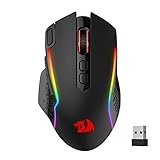
Wireless gear carries a price premium for the same sensor and switches, and rechargeable batteries do degrade over several years. Wired peripherals cost less upfront and have one fewer component to fail. That said, the gap has narrowed: budget wireless options like the Redragon M810 PRO deliver genuine cordless freedom for the price wired flagships once commanded, making wireless a reasonable default even for value-focused buyers.
Tips
- For competitive shooters, prioritize a wireless mouse with a dedicated 2.4GHz dongle and skip Bluetooth for anything fast.
- Always use the USB extender that ships with wireless gear to place the receiver near your hand and cut interference.
- Charge headsets and rechargeable mice on a fixed schedule (overnight) so low battery never interrupts a session.
- If you go wired, invest in a mouse bungee; it removes most cable drag and makes wired feel nearly cordless.
Frequently Asked Questions
Is wireless gaming gear good enough for competitive play in 2026?
Yes. Modern 2.4GHz wireless mice and keyboards add only 1 to 2 milliseconds of latency, which is imperceptible in practice. Pro players across major esports now use wireless mice regularly, so the technology is no longer a competitive handicap.
Does Bluetooth work for gaming?
Bluetooth is fine for travel, productivity, and slow-paced or turn-based games, but its higher latency makes it a poor choice for shooters, fighting games, or anything requiring precise timing. Use a dedicated 2.4GHz dongle for gaming and save Bluetooth for a laptop on the go.
Will a wireless mouse battery die in the middle of a game?
Only if you ignore it. Most gaming mice warn you at low battery, and many support charging while you play through their cable. Building a simple charging habit makes battery anxiety a non-issue, and lightweight AA-powered models can run for weeks.
Do wired peripherals still have any real advantage?
They do: lower cost for the same components, zero charging, one less thing to fail, and no chance of wireless interference. If budget is tight or you never want to think about batteries, wired remains a completely valid and often smarter choice.
Conclusion
There is no universally correct answer, only the right fit for your setup. If you value a clean, drag-free desk and are willing to manage batteries, modern wireless gear delivers effectively identical performance with far more comfort. If you prioritize the lowest cost, zero maintenance, and absolute connection certainty, wired still earns its place. Match the technology to how you play, buy from a reputable line with a proven low-latency protocol, and you will be happy either way.