Key takeaways
- Immersion: Curved panels wrap the periphery into view and hold you inside the frame; flat panels present the image as a window you look at rather than into.
- Viewing distance: Curves reward close seating — roughly 60–80cm for a 1500R panel — while flat screens stay comfortable at any distance and from any seat in the room.
- Geometry and straight lines: Flat screens keep architectural lines, spreadsheets, and CAD grids perfectly true; aggressive curves introduce mild bowing that some users notice immediately.
- Panel technology: Most curves in this price band are VA, delivering deep blacks and strong contrast — the SANSUI 27″ 240Hz quotes 4000:1 — whereas flat budget models more often use IPS with wider viewing angles.
- Desk footprint: A 32-inch curve occupies more depth but feels narrower in use; flat panels sit flush against a wall and mount more cleanly on arms and shallow desks.
- Multi-monitor use: Flat screens tile seamlessly side by side; matching curved bezels into an array is possible but rarely looks tidy unless all panels share a radius.
What's inside
Walk into any gaming setup discussion in 2026 and the curved-versus-flat debate resurfaces within minutes. What has genuinely changed is the price gap. Curved panels once carried a clear premium, but high-refresh VA curves at 1080p and 1440p now sit in the same bracket as comparable flat screens. That shifts the decision away from budget and toward how you actually play, where you sit, and what else the display has to do when the game is closed.
The short version is that curvature is a viewing-geometry tool, not a marketing gimmick. Bending the edges of the panel toward you keeps the distance between your eye and any point on the screen roughly constant, which reduces off-axis colour shift and pulls the periphery into your natural field of view. On a large monitor at close range, that is genuinely useful. On a smaller panel viewed from further back, the benefit shrinks fast. Here is how each format performs, and which curved screens are worth your money right now.
As an Amazon Associate we earn from qualifying purchases at no extra cost to you.


⚡ Save on Your Next PC — Amazon Prime
Prime members get fast free shipping on the systems above, plus early access to Prime Day & Black Friday PC deals. New members get a 30-day free trial.
Watch: Curved vs Flat Gaming Monitor: 2026 Guide — Video Review
Quick Verdict
Choose curved if you sit within arm’s reach of a 27-inch or larger display and mostly play immersive single-player, racing, or open-world titles — the Samsung 32″ Odyssey G55C at QHD and 1000R is the standout here, with the SANSUI 27″ Curved 240Hz covering the high-refresh budget end. Choose flat if you split time between gaming and precision work, run a multi-monitor array, or play competitive shooters where a perfectly straight reference line matters more than wraparound presence.
Key Differences
- Immersion: Curved panels wrap the periphery into view and hold you inside the frame; flat panels present the image as a window you look at rather than into.
- Viewing distance: Curves reward close seating — roughly 60–80cm for a 1500R panel — while flat screens stay comfortable at any distance and from any seat in the room.
- Geometry and straight lines: Flat screens keep architectural lines, spreadsheets, and CAD grids perfectly true; aggressive curves introduce mild bowing that some users notice immediately.
- Panel technology: Most curves in this price band are VA, delivering deep blacks and strong contrast — the SANSUI 27″ 240Hz quotes 4000:1 — whereas flat budget models more often use IPS with wider viewing angles.
- Desk footprint: A 32-inch curve occupies more depth but feels narrower in use; flat panels sit flush against a wall and mount more cleanly on arms and shallow desks.
- Multi-monitor use: Flat screens tile seamlessly side by side; matching curved bezels into an array is possible but rarely looks tidy unless all panels share a radius.
Curved Gaming Monitors
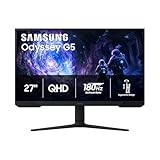
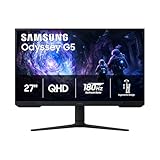
Curvature earns its keep as screen size grows. The Samsung 32″ Odyssey G55C is the clearest example: a 1000R radius on a QHD 32-inch panel at 165Hz produces a viewing envelope that genuinely fills your vision, and the sharper pixel density stops the extra size from looking soft. For sim racing, flight, and cinematic RPGs, this is the configuration to beat under a moderate budget. The SANSUI 32″ Curved 240Hz takes the opposite approach with a gentler 1500R curve and FHD resolution, trading sharpness for raw frame rate on modest hardware.
At 27 inches the case is narrower but still real. The SANSUI 27″ Curved 240Hz pairs a 1500R curve with 130% sRGB coverage and 1ms MPRT, making it a credible fast-paced option, while the SANSUI 27″ Curved 160Hz is the sensible pick if your GPU cannot feed 240 frames anyway. The Samsung 27″ Essential S3 (S36GD) at 100Hz and 1800R is the mildest curve of the group — closer to a comfort feature than an immersion one — and suits mixed home use more than serious competitive play.
Flat Gaming Monitors
Flat panels remain the safer default, and in several scenarios the better one. If your monitor doubles as a work display for design, photo editing, video timelines, or anything involving straight reference edges, curvature is a persistent low-level annoyance. Flat IPS screens also hold colour accuracy across wider angles, which matters if anyone else ever looks at your screen or you occasionally play from a sofa rather than a desk chair.
Competitive players tend to land here too. In CS-class shooters and fighting games, the entire playfield already sits within your central vision at 24 to 27 inches, so a curve adds nothing while subtly altering crosshair-to-edge geometry that muscle memory relies on. Flat panels are also easier to wall-mount, easier to arrange in dual or triple configurations, and generally cheaper to replace when a better refresh rate arrives.
Which Should You Buy?
- For immersive single-player and sim racing: pick curved, ideally 32-inch QHD like the Samsung Odyssey G55C.
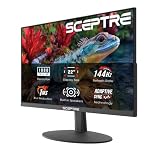
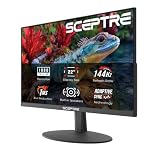
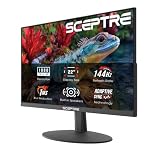
- For competitive FPS on a budget: pick a fast 24–27 inch panel; the Sceptre 24-inch C248W is the compact curved option, though a flat 24-inch is equally valid.
- For mixed work and play: pick flat, or accept the gentlest curve available such as the Samsung S3 27-inch at 1800R.
- For a dual or triple monitor wall: pick flat — matching curves across panels rarely aligns cleanly.
- For maximum frames per dollar: pick the SANSUI 27″ Curved 240Hz, which delivers flagship refresh rates at entry-level pricing.
Frequently Asked Questions
Do curved monitors reduce eye strain?
Modestly, yes. Keeping eye-to-pixel distance consistent reduces the refocusing your eyes do when scanning edge to edge, which can help during long sessions. The effect is small on 24-inch panels and more noticeable at 32 inches and above.
Is a curved monitor worth it at 24 inches?
Rarely for immersion, since the panel already sits inside your central vision. Models like the Sceptre 24-inch are worth buying for their price and specification rather than the curve itself.
Does curvature hurt competitive performance?
Not measurably. Professional players use both. The adjustment period is a few hours at most, but if you have built years of muscle memory on flat panels, there is little reason to switch.
What curvature radius should I choose?
Lower numbers mean tighter curves. 1000R is the most aggressive and best suited to 32-inch panels at close range; 1500R is the versatile middle ground; 1800R is subtle and works well for mixed productivity use.
Final Verdict
Buy curved when the screen is large, close, and dedicated to immersive gaming — the Samsung 32″ Odyssey G55C is the best-balanced choice in that category, with the SANSUI 27″ Curved 240Hz leading on value. Buy flat when precision, multi-monitor flexibility, or shared work use matters more than presence. Neither format is objectively superior in 2026; the right answer is dictated by your desk, your seating distance, and the genres you actually play.