Key takeaways
- Size your PSU around your graphics card first, since it is the single largest and spikiest power draw in a gaming build.
- Prefer an ATX 3.1 unit with a native 12V-2×6 cable so your GPU is powered cleanly without adapters.
- Do not chase the highest wattage number; a quality 850W Gold unit beats a no-name 1200W one on reliability every time.
- Register the warranty after purchase, as premium PSUs often require registration to unlock their full coverage period.
What's inside
- Watch: What PSU Do I Need for Gaming? (2026 Guide) — Video Review
- How Much Wattage Do You Really Need?
- Efficiency Ratings and Why They Matter
- ATX 3.1 and the New GPU Connector
- Modular vs Non-Modular Cabling
- Read the Warranty as a Quality Signal
- Tips
- Related Guides
- Frequently Asked Questions
- Conclusion
- Related Articles
- Related Guides
The power supply is the quietest, least glamorous part of a gaming PC, and also the one you should never cut corners on. It feeds clean, stable power to every other component, and a cheap or undersized unit can cause random crashes, throttled performance, or in the worst cases damage the expensive hardware it is supposed to protect. Yet many builders treat the PSU as an afterthought, grabbing whatever fits the budget after the flashy parts are chosen. In 2026, with power-hungry graphics cards and new ATX standards, that approach is riskier than ever.
- Watch: What PSU Do I Need for Gaming? (2026 Guide) — Video Review
- How Much Wattage Do You Really Need?
- Efficiency Ratings and Why They Matter
- ATX 3.1 and the New GPU Connector
- Modular vs Non-Modular Cabling
- Read the Warranty as a Quality Signal
- Tips
- Related Guides
- Frequently Asked Questions
- Conclusion
- Related Articles
- Related Guides
This guide explains how to choose the right power supply for your gaming rig without overpaying or underspending. You will learn how to estimate the wattage you actually need, why the 80 Plus efficiency rating and modern ATX 3.1 standard matter, what modular cabling gets you, and how to read a warranty as a signal of quality. Our recommended units above cover everything from dependable mid-wattage builds to high-end systems, so you can match a proven PSU to your exact needs.
As an Amazon Associate we earn from qualifying purchases at no extra cost to you.




⚡ Save on Your Next PC — Amazon Prime
Prime members get fast free shipping on the systems above, plus early access to Prime Day & Black Friday PC deals. New members get a 30-day free trial.
Watch: What PSU Do I Need for Gaming? (2026 Guide) — Video Review
How Much Wattage Do You Really Need?
Wattage should be driven by your graphics card and CPU, since they consume the vast majority of a gaming PC’s power. Add up the rated draw of those two components, then leave a comfortable buffer of roughly 30 percent for spikes, future upgrades, and efficient operation. For most single-GPU gaming builds in 2026, a 750W to 850W unit hits the sweet spot, while high-end cards paired with a top-tier CPU are happier with 1000W. Buying far more than you need wastes money, but a small buffer is always wise.
Efficiency Ratings and Why They Matter
The 80 Plus rating tells you how much of the power drawn from the wall actually reaches your components rather than being lost as heat. Ratings climb from Bronze through Gold to Platinum, and for a gaming PC, Gold is the practical sweet spot: noticeably efficient, cooler running, and widely available. Higher efficiency means less wasted electricity, quieter fans, and often better internal components overall. It is one of the clearest quality signals on the box.
ATX 3.1 and the New GPU Connector
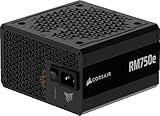
Modern graphics cards can demand sudden, brief power spikes far above their steady draw, and the ATX 3.1 standard was designed to handle exactly that. An ATX 3.1 unit with a native 12V-2×6 connector powers current GPUs directly with a single cleanly seated cable, avoiding the adapter clutter and connection worries of older designs. If you are buying a new PSU in 2026, choosing an ATX 3.1 and PCIe 5.1 ready model like the MSI MAG or CORSAIR RMe series future-proofs your build against the next few generations of cards.
Modular vs Non-Modular Cabling
Modularity decides how you manage cables inside the case. A fully modular PSU lets you attach only the cables you use, which makes for a cleaner build, better airflow, and easier installation. A non-modular unit has every cable permanently attached, saving a little money but leaving you to tuck away unused leads. For most gaming builds the improved airflow and tidiness of a fully modular unit are well worth the modest premium.
Read the Warranty as a Quality Signal
A power supply’s warranty length is a surprisingly honest indicator of how much the manufacturer trusts it. Budget units often carry short coverage, while premium models back their internal capacitors and build quality with seven to ten years. A long warranty like the ten-year coverage on the MSI, ASUS TUF, and ASUS ROG Strix units above signals confidence that the PSU will outlast several of your other components, which is exactly what you want from the part protecting your whole system.
Tips
- Size your PSU around your graphics card first, since it is the single largest and spikiest power draw in a gaming build.
- Prefer an ATX 3.1 unit with a native 12V-2×6 cable so your GPU is powered cleanly without adapters.
- Do not chase the highest wattage number; a quality 850W Gold unit beats a no-name 1200W one on reliability every time.
- Register the warranty after purchase, as premium PSUs often require registration to unlock their full coverage period.
Frequently Asked Questions
Can a power supply be too powerful for my PC?
Not in a harmful way. A higher-wattage unit simply runs at a lower percentage of its capacity, which is efficient and quiet, and it leaves room for future upgrades. The only downside is spending more than necessary, so aim for a sensible buffer rather than the biggest number available.
Is 650W enough for a gaming PC in 2026?
It can be for an entry-level or mid-range build with a modest graphics card, but many current GPUs are happier with 750W or more once you account for power spikes. If you plan to upgrade your card later, starting at 750W to 850W gives you valuable headroom.
Do I need ATX 3.1, or is an older PSU fine?
An older quality PSU can still power a modern system through an adapter, but ATX 3.1 units handle the transient spikes of new GPUs more gracefully and connect with a single native cable. For a new build in 2026, ATX 3.1 is the safer and cleaner choice.
Does the PSU affect gaming performance?
Indirectly, yes. A good PSU does not raise your frame rate on its own, but an underpowered or unstable one can cause crashes and throttling that ruin performance. Reliable, clean power lets the rest of your components run at their full potential without interruption.
Conclusion
Choosing a gaming power supply comes down to matching wattage to your components, insisting on solid efficiency and the modern ATX 3.1 standard, and treating a long warranty as proof of quality. It is not the part that wins bragging rights, but it is the one that keeps everything else running safely for years. Pick a proven unit sized with a little headroom, and your PSU will quietly do its job long after you have upgraded the flashier hardware around it.