Key takeaways
- Panel technology: IPS delivers accurate color and wide viewing angles for productivity, while OLED offers perfect blacks and instant response for gaming and movies. Pick based on how you spend the most time.
- Refresh rate: A 60Hz panel is fine for office work, but 120Hz, 180Hz, or 240Hz makes motion dramatically smoother. Only chase high refresh if your GPU can actually feed it at 4K.
- HDR and brightness: Look for at least DisplayHDR 400 for meaningful highlights, and True Black 400 on OLED for cinematic contrast. Cheap “HDR” labels on 300-nit panels add little.
- Connectivity: USB-C with power delivery simplifies laptop docking, while DisplayPort 2.1 or HDMI 2.1 is essential to hit high refresh rates without compression.
- Ergonomics and size: A 27-inch 4K panel is razor sharp, while 32 inches gives you more workspace at the cost of pixel density. Height, tilt, and pivot adjustment matter more than most buyers expect.
What's inside
Stepping up to 4K in 2026 is no longer the luxury it once was. Panel prices have tumbled, high-refresh IPS and OLED options are everywhere, and even mid-range graphics cards can now push a crisp 3840×2160 image for both work and play. Whether you are editing photos, grinding through spreadsheets, or diving into the latest AAA titles, a good ultra-high-definition display changes the whole experience.
The tricky part is that “4K” alone tells you very little. Refresh rate, panel technology, HDR performance, and connectivity all shape how a monitor actually feels day to day. Below we break down the standout 4K monitors worth buying this year, then walk through exactly how to match one to your setup and budget.
As an Amazon Associate we earn from qualifying purchases at no extra cost to you.


⚡ Save on Your Next PC — Amazon Prime
Prime members get fast free shipping on the systems above, plus early access to Prime Day & Black Friday PC deals. New members get a 30-day free trial.
Watch: Best 4K Monitor 2026 — Video Review
How to Choose a 4K Monitor in 2026
- Panel technology: IPS delivers accurate color and wide viewing angles for productivity, while OLED offers perfect blacks and instant response for gaming and movies. Pick based on how you spend the most time.
- Refresh rate: A 60Hz panel is fine for office work, but 120Hz, 180Hz, or 240Hz makes motion dramatically smoother. Only chase high refresh if your GPU can actually feed it at 4K.
- HDR and brightness: Look for at least DisplayHDR 400 for meaningful highlights, and True Black 400 on OLED for cinematic contrast. Cheap “HDR” labels on 300-nit panels add little.
- Connectivity: USB-C with power delivery simplifies laptop docking, while DisplayPort 2.1 or HDMI 2.1 is essential to hit high refresh rates without compression.
- Ergonomics and size: A 27-inch 4K panel is razor sharp, while 32 inches gives you more workspace at the cost of pixel density. Height, tilt, and pivot adjustment matter more than most buyers expect.
The Best 4K Monitors Reviewed
Dell S2725QS 27-inch 4K IPS
Dell’s S2725QS is the sensible all-rounder of this list. Its 120Hz IPS panel covers 99% sRGB with a 1,500:1 contrast ratio, and the fully adjustable stand handles height, swivel, and pivot with ease. USB-C, HDMI, and DisplayPort round out a package that suits home offices and casual gamers alike without breaking the bank.
LG 27UP650K-W UltraFine 4K
The 27UP650K-W leans into color-critical work with DisplayHDR 400 certification and a clean white chassis. Reader Mode and Flicker Safe help during long editing sessions, and the tilt/height/pivot stand makes it flexible in tight spaces. At 60Hz it is aimed squarely at creators rather than competitive gamers.
Samsung 32-inch ViewFinity S7 (S70H)
If you want more real estate, the 32-inch ViewFinity S7 spreads 4K across a roomy panel with HDR10 and Eye Saver Mode. Samsung’s Display Manager makes juggling multiple sources painless, and the extra screen area is a genuine productivity boost for multitasking and content layout.
LG 32GX870A-B UltraGear 4K OLED
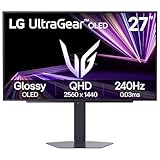
This is the gaming showpiece. The 32GX870A-B pairs a 240Hz OLED panel with a 0.03ms response time, Dual-Mode switching, and VESA DisplayHDR True Black 400. USB-C and DP2.1 keep the signal pristine, and the inky OLED contrast makes both games and films look spectacular.
LG 27US500-W UltraFine 4K
The 27US500-W is the value pick for anyone who just wants sharp 4K without frills. Its borderless IPS design, HDR10 support, and Flicker Safe switching make it an easy desktop companion, and the clean white styling looks great in a bright room.
Frequently Asked Questions
Is 27 or 32 inches better for 4K?
A 27-inch 4K panel has higher pixel density and looks incredibly crisp up close, while 32 inches gives you more usable workspace with slightly softer text. Choose 27 for sharpness at a normal desk distance and 32 if you multitask heavily.
Do I need a powerful GPU for a 4K monitor?
For office work and video, almost any modern GPU or integrated graphics will drive 4K at 60Hz. For high-refresh gaming at 4K, you will want a recent mid-to-high-end graphics card to reach those higher frame rates.
Is OLED worth it over IPS for a 4K monitor?
OLED delivers perfect blacks, near-instant response, and stunning contrast that IPS cannot match, making it ideal for gaming and movies. IPS still wins on sustained brightness and long-term burn-in peace of mind for static productivity work.
What cable do I need for 4K at high refresh rates?
Use DisplayPort 2.1 or HDMI 2.1 to run 4K above 120Hz without visual compression. Standard HDMI 2.0 caps out around 4K 60Hz, so check both the monitor and your GPU ports before buying.
Final Thoughts
The best 4K monitor for you comes down to how you use your desk. Creators and office users will love the color accuracy and ergonomics of the Dell and LG IPS panels, while gamers should stretch for the UltraGear OLED to enjoy that buttery 240Hz motion. Whichever you pick, 2026 is a fantastic year to make the jump to 4K.